Buying Guides
Yellow Kitchen Ideas: 9 Shades and Where to Put Them

By the Hill & May team
Updated 2026
A yellow kitchen goes wrong in exactly one way: too much of a yellow that is too clean. Primary, high-chroma yellow on every door turns a room into a bounce card, and everything in it, including the people, picks up a sallow cast. Use the older, dirtier yellows instead, the ones with ochre or green or brown buried in them, and put them in the right places, and yellow becomes the warmest colour available to a country kitchen. It is the shade that makes a north-facing room feel like it has more windows than it does.
Below are nine ways to use it, from a full cast-iron range in mustard enamel down to a single painted plate rack.
1. A mustard range cooker instead of yellow cabinets
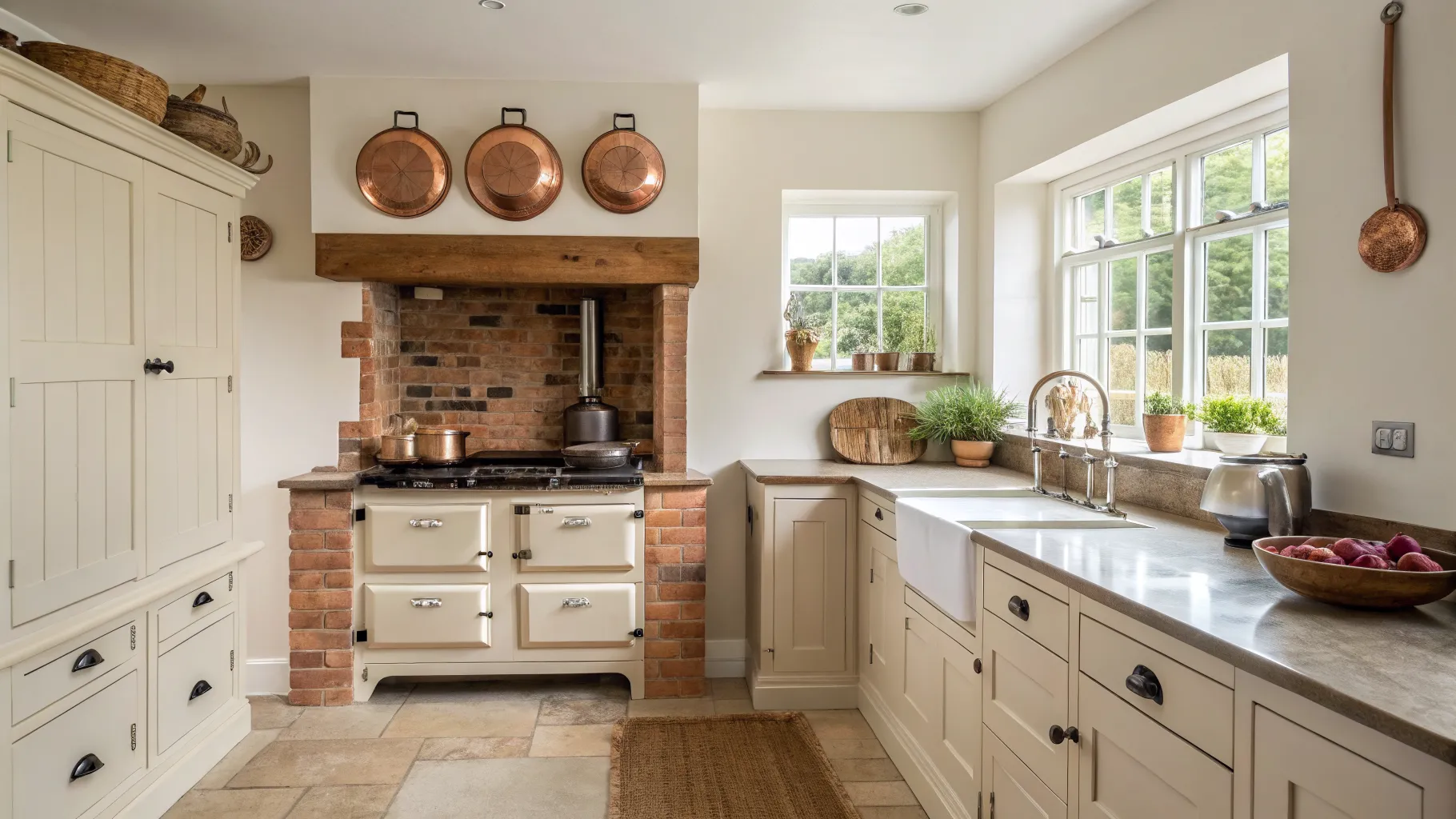
If you want the colour to do real work, put it on the cooker. AGA introduced Mustard in 2025, describing it as golden, warm and lively, and it is available across the all-electric cast-iron AGA range in sizes from 60cm up to 210cm. AGA’s own suggested pairings are dark blue, burgundy, sage and natural wood, which is a fair summary of what mustard actually likes.
The advantage over painted cabinets is proportion. A range is a big object but a small percentage of the room, so you get an unmissable hit of colour without committing thirty cupboard doors to a shade you might tire of. Rangemaster’s current painted finishes run to blacks, slates, creams, a Bordeaux, a mint and a heather rather than a yellow, so if you specifically want a yellow range cooker, AGA is the mainstream route or you are looking at re-enamelling a reconditioned body. Our AGA range cooker guide and Rangemaster cookers guide cover what each brand currently offers.
2. Pick a historic yellow, not a modern one
The reason period yellows work in kitchens is that they are pigment-based colours with something muddy in them. Farrow & Ball’s yellow range is the easiest place to see the distinction.
India Yellow No.66 is the most intense of them, a deep saffron-brown that the company describes as making a room look as though it is lit by electric light even when it is not. It is a wall colour, or a colour for one dresser, and it is not a whole-kitchen colour.
Sudbury Yellow No.51 is the soft mid yellow, named after the staircase at Sudbury Hall. It shifts noticeably with the light, reading cleaner and brighter in a well-lit room and softening considerably in a dim one, which makes it a genuine sample-pot-first colour.
Yellow Ground No.218 and Dayroom Yellow No.233 sit in the lighter, sunnier band and behave more like a warm neutral than a statement.
Straw No.52, Farrow’s Cream No.67 and Dorset Cream No.68 are barely yellow at all, and they are the ones to reach for if you want warmth without anyone describing the room as a yellow kitchen.
3. Use yellow on the island and cream on the perimeter
The single safest structure for a yellow kitchen is the one that works for every strong colour: the island in the colour, the runs of units in cream or off-white. It gives you a centrepiece, keeps the walls of cupboards quiet, and means the yellow reads as a deliberate choice rather than a decorating decision that got away from someone.
Yellow and cream is also the historically correct pairing. A cream Shaker perimeter with a mustard or ochre island, oak worktops and a stone floor is essentially a Georgian kitchen scheme, and it does not date. Our cream kitchen ideas piece covers the perimeter side of that.
4. Put it on the walls and leave the cabinets alone
Wall paint is the cheapest reversible commitment in a kitchen, and in a room where cabinets take up most of the vertical surface, the amount of visible wall is small enough that you can go much stronger than you would in a living room.
This is where India Yellow earns its reputation. On the two or three metres of wall between wall units and worktop, or on the chimney breast around a range, a deep ochre glows against cream cabinetry and warms everything the light touches. In a north-facing or single-window kitchen it is the most effective thing you can do for not much money.
5. Yellow with green, not yellow with grey
Yellow’s best partner in a country kitchen is green, and specifically a muted, olive-leaning green rather than a bright one. The two sit next to each other on the colour wheel, they share a pigment history, and every English garden has been demonstrating the combination for centuries.
Grey is the pairing to be careful with. Cool grey pulls the warmth out of yellow and leaves it looking acidic, which is how a lot of 2015-era yellow-and-grey kitchens ended up looking tired within five years. If you want a neutral against yellow, use a warm stone, a mushroom or an off-white with a yellow base rather than a blue-based grey. For the green side of the pairing see our sage green kitchen ideas.
6. Ochre on a freestanding dresser or larder
A freestanding piece is the lowest-risk way to introduce a saturated yellow, because if it stops working you move it or repaint one item rather than a fitted kitchen.
The classic version is a dresser painted a deep ochre with the interior in a lighter tone, so the shelves and whatever sits on them read against the back panel. The same idea works on a larder cupboard, particularly if you paint only the inside of the doors so the colour appears when the cupboard is open and disappears when it is closed. Little Greene’s Mister David No.47 is the bright end of this idea, a deep sunshine yellow they recommend in Intelligent Eggshell for cabinetry because it stands up to moisture and wear better than an emulsion. You can see the shade on the Little Greene Mister David page.
7. Yellow on the small joinery only
If the room is already finished and you are not repainting anything structural, yellow works in doses measured in centimetres.
The beading on a plate rack. The inside edge of an open shelf. A single painted chair at the end of a run of stripped wood ones. The frame of a pantry door. Because the dose is tiny, you can use a much brighter, happier yellow than you would ever put on a cabinet run, and it lifts a neutral scheme without any of the risk.
8. Yellow through fabric and tile rather than paint
Paint is not the only route, and in a kitchen where the cabinetry is already decided, textile and ceramic are the flexible layer.
A yellow-and-white checked blind, a mustard seat pad on a bench, a stack of ochre-glazed bowls on an open shelf, or a run of hand-glazed splashback tiles in a mottled yellow will all read as a yellow kitchen without a brush going near a door. Handmade tiles are worth the premium here specifically because the glaze varies across the batch, which stops the yellow from reading as a flat manufactured sheet.
9. Test it against your actual light, twice a day
Yellow is the colour most affected by the light falling on it, and Sudbury Yellow is the standard example: cleaner and brighter in a bright room, distinctly softer in a dark one. The same pot of paint genuinely produces two different colours in two different kitchens.
Paint a sample on a large piece of card rather than the wall, so you can move it around, and look at it in morning daylight, in overcast afternoon light and under whatever bulbs you use at night. Warm-white LEDs at 2700K push yellow further towards orange; cool-white ones at 4000K flatten it and can make it look green. If the kitchen is where the family eats after dark, judge the colour after dark. Our kitchen cupboard paint guide covers finishes and preparation, and kitchen colour ideas sets yellow alongside the other options.
Frequently asked questions
Is a yellow kitchen a bad idea for resale? Only if the yellow is bright and everywhere. A muted ochre or mustard on an island, a dresser or the walls reads as a considered scheme and repaints in a weekend. Thirty doors in a saturated primary yellow is the version buyers price down, and that is true of any strong colour used at that scale.
What colour worktop goes with a yellow kitchen? Oak or another warm timber is the natural answer, because wood shares yellow’s undertone and the two settle together. Honed dark granite and slate also work by contrast, grounding the scheme at worktop height. Avoid a bright white quartz, which fights the warmth and makes the yellow look dirty by comparison.
Which yellow works in a north-facing kitchen? A yellow with real depth rather than a pale one. North light is cool and blue-shifted, and it drains pale yellows until they look grey-green. Deeper ochres such as India Yellow hold their colour and actively warm the room, which is the opposite of what a pale primrose does in the same light.
Can I have a yellow AGA? Yes. AGA’s Mustard, introduced in 2025, is available across its all-electric cast-iron range from 60cm to 210cm. Reconditioned AGAs can also be re-enamelled in yellows that are no longer standard, which is how most of the older yellow AGAs in British kitchens came about.
Does yellow work in a small kitchen? It does, but choose the placement carefully. A light yellow on the walls of a small kitchen reflects light around and makes the room feel larger; a saturated yellow on all the cabinetry in the same space becomes overwhelming quickly. In a galley, put the colour above the worktop and keep the units pale.
What is the difference between mustard and ochre? Ochre is the pigment name, a natural earth colour that ranges from golden yellow to brown depending on the iron content. Mustard is a decorating term for a yellow with brown and a touch of green in it. In practice they overlap heavily, and both describe the muted, dirty yellows that suit a country kitchen far better than a clean primary.