Buying Guides
Kitchen Cupboard Paint: Which Ones Skip the Primer

By the Hill & May team
Updated 2026
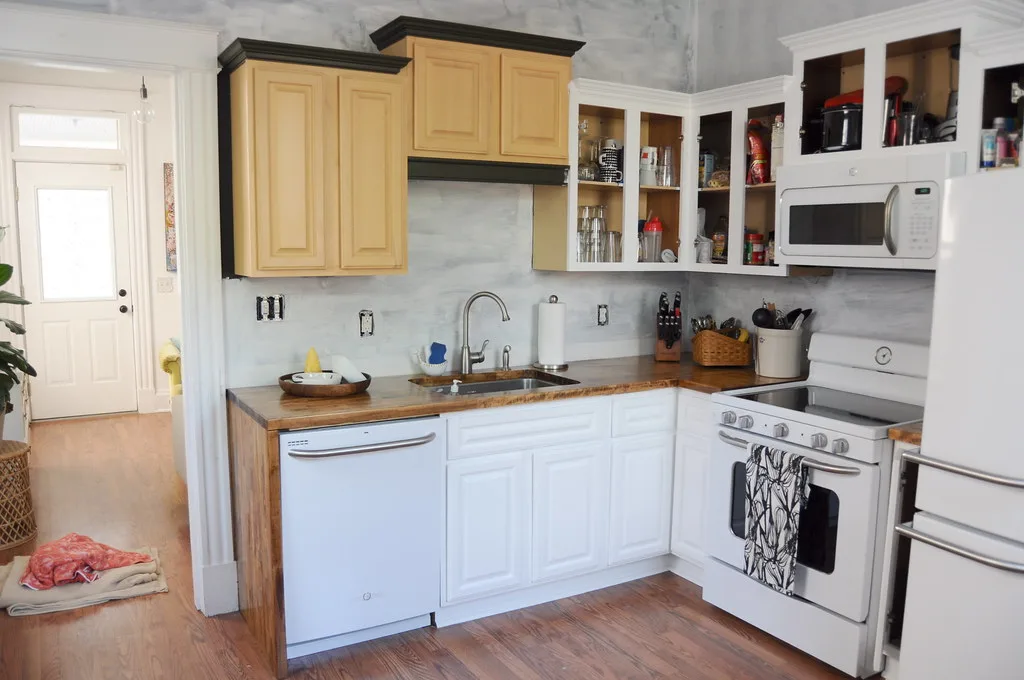
Choosing kitchen cupboard paint comes down to one question that almost every buying guide skirts: what are your doors actually made of? Solid timber, MDF with a sprayed finish, melamine-faced chipboard and vinyl-wrapped MDF all take paint differently, and the paint that gives a flawless result on one will lift off another within a year. The good news is that several manufacturers now make paints specifically for cupboards that go straight onto melamine and old gloss with no primer, which removes the step most people get wrong.
Work out what your doors are first
Open a door and look at the back edge, and at the underside of a drawer front. That is where the construction gives itself away.
- Solid timber or timber-veneered. Visible grain that continues round the edge, and end grain on the top and bottom rails. Takes almost anything, wants light sanding, and will need grain filler if you want a truly flat finish.
- Painted or sprayed MDF. No grain, a crisp routed profile, and a uniform surface. The easiest thing to repaint well.
- Melamine-faced chipboard. A printed woodgrain that repeats, a hard plasticky surface, and chipboard visible on any cut edge. Needs either a purpose-made cupboard paint or a proper adhesion primer.
- Vinyl-wrapped MDF. This is the one to identify. A thin plastic film heat-wrapped over MDF, with a faint seam on the back face where the film ends. Common on kitchens fitted from the late 1990s onwards, and the surface most likely to fail.
Vinyl wrap deserves its own warning. The film is bonded to the MDF, and paint sits on top of the film rather than on the door. If the wrap has already lifted anywhere, usually at a corner near the oven where heat has got at it, painting will not stop it and you will end up with paint peeling away in a sheet with the vinyl underneath. Check every door edge before you buy anything. If more than one or two have started to lift, replacing the doors is the honest answer.
The paints, and what each one is genuinely for
Specifications below come from each manufacturer’s own product information, checked August 2026.
| Paint | Primer needed | Finish | Coverage per litre | Recoat | Goes onto melamine? |
|---|---|---|---|---|---|
| Rust-Oleum Kitchen Cupboard Paint | No | Matt, satin or gloss | Up to 14m² | 4 hours | Yes, stated |
| Johnstone’s Revive Cupboard Paint | No | Satin | Up to 12m² | 1 to 2 hours | Yes, plus MDF and plastic |
| Farrow & Ball Modern Eggshell | Undercoat advised on bare surfaces | 40% sheen | Up to 12m² | 4 hours | Not its intended use |
| Frenchic Al Fresco | No, self-priming | Matt chalky | Varies by tin | Per tin | Yes, and laminate |
Rust-Oleum Kitchen Cupboard Paint is the default recommendation for a reason. Rust-Oleum’s own product page states no priming or sanding is necessary, it goes over old paint and varnish as well as gloss and melamine, and it covers up to 14m² per litre, the best of the four. Two coats are recommended, touch dry in an hour, hard dry in four, and full cure at seven days. That last figure is the one people ignore: the paint is dry enough to rehang doors long before it is hard enough to take a fingernail or a tea towel dragged across it. Give it the week before you treat the kitchen normally.
Johnstone’s Revive is the value option and does the same job with a shorter recoat window, 1 to 2 hours rather than 4, which matters if you are trying to get both coats on in a day. It goes onto wood, MDF, melamine and plastic without priming, in a satin finish only. Coverage is up to 12m² per litre, and a 750ml tin covers around 9m², which is roughly the door and drawer fronts of a small galley kitchen with nothing to spare.
Farrow & Ball Modern Eggshell is a different proposition. It is a general interior wood, metal and concrete finish rather than a cupboard-specific paint, with a 40% sheen and coverage of up to 12m² per coat, dry in 2 hours and recoat in 4, per Farrow & Ball’s Modern Eggshell page. It is genuinely tough, and if you want a specific F&B colour to run from your kitchen walls onto the units it is the right product. What it is not is a shortcut: on melamine or vinyl you still need an adhesion primer underneath, and skipping that is the single most common reason a Farrow & Ball cupboard job fails.
Frenchic Al Fresco is a water-based chalk and mineral paint, self-priming and self-sealing, matt by default with the option of a topcoat if you want more sheen. It suits the softer, slightly textured look that works in a cottage or traditional kitchen rather than a crisp modern one. It is forgiving to apply and the chalky finish hides a less-than-perfect substrate, which is its real advantage.
Dulux does make cupboard-suitable products, but unlike Johnstone’s Revive they generally expect you to prep and prime properly first. If you are choosing on convenience, that is the difference.
Preparation, which is where the result is decided
The paint matters less than what happens before it. In order:
- Take the doors off and label them. Masking tape on the inside of each door with a number, and the same number pencilled inside the carcass. Painting doors in situ produces runs on the bottom edge and paint on the hinges, and you cannot get a clean line at the top.
- Degrease properly, twice. This is the step that decides adhesion, and almost every failed cupboard paint job comes back to it. Kitchen doors carry a film of atomised cooking oil that is invisible and completely defeats paint. Sugar soap or a proper degreaser, then a clean water rinse, then let them dry fully. The doors either side of the hob need it most.
- Sand only if the paint asks for it. The no-primer paints are formulated to bite without sanding. A light key with 240 grit does no harm on gloss and helps, but sanding through a vinyl wrap or a melamine face exposes the board underneath and creates a problem you did not have.
- Fill and repair while the doors are off. Old handle holes need filling from both sides if you are changing to a different centre spacing. Our guide to kitchen door handles covers matching new hardware to existing holes.
- Paint the carcasses and the door edges too. Cupboard interiors can usually stay as they are, but the visible front edge of the carcass must match or the whole kitchen reads as unfinished.
- Thin coats, two of them, and resist a third. Cupboard paints build a hard film as they cure. A thick coat skins over and stays soft underneath for weeks, then marks permanently the first time something knocks it.
- Wait out the cure before rehanging anything you care about. Seven days for Rust-Oleum. Doors closed against a soft carcass edge before the paint has cured is how you get the two surfaces bonding together and tearing when opened.
Brush, roller or spray: a small foam gloss roller followed immediately by light brush strokes in one direction gives the most consistent result for most people. Spraying is better but needs masking of the entire room and a dust-free space to lay the doors, which in practice means a garage.
What repainting does not fix
Being straight about this saves money. Paint changes colour and finish. It does not change:
- Worn hinges and soft-close mechanisms. A repainted door that still drops is a repainted door that drops.
- Swollen chipboard under the sink. Water damage to the carcass base is structural. Paint over it and it stays swollen.
- A layout that does not work. If the problem is where things are rather than what colour they are, see our guides to kitchen corner units and kitchen island ideas instead.
- Doors that were the wrong size to begin with. Uneven gaps are more obvious in a strong colour, not less.
Painting is roughly a weekend of work and a fraction of the cost of new doors, which our kitchen renovation cost guide puts in context. It buys several years on a kitchen whose carcasses are sound. It does not buy a new kitchen.
Colour, briefly
Dark colours show every imperfection in the substrate and every brush mark, and they show dust and fingerprints on a satin finish. They also look excellent, which is why people keep choosing them. If you are going dark, spend longer on preparation than you planned and consider a matt rather than a satin. Our pages on navy blue kitchen ideas, green kitchen ideas and black kitchen ideas show how they sit against different worktops.
Paint the two least visible doors first. Whatever your technique problems are, that is where you will discover them.
Frequently asked questions
Do you need to sand kitchen cupboards before painting? Not with the cupboard-specific paints. Rust-Oleum Kitchen Cupboard Paint and Johnstone’s Revive both state no primer or sanding is needed, including over gloss and melamine. Degreasing is not optional though, and it matters more than sanding: cooking oil residue on the doors will stop any paint adhering.
Can you paint vinyl-wrapped kitchen doors? You can paint the vinyl, but you cannot fix the vinyl. Paint adheres to the film, not the MDF underneath, so if the wrap has already started lifting anywhere the paint will come away with it. Check every door edge, particularly near the oven and kettle, before deciding.
What is the best paint for melamine kitchen cupboards? A paint that names melamine on the tin. Rust-Oleum Kitchen Cupboard Paint states it works on melamine and gloss without priming, and Johnstone’s Revive lists melamine alongside wood, MDF and plastic. Standard eggshell or emulsion will not bond to melamine without an adhesion primer first.
How long does painted kitchen cupboard paint take to cure? Longer than it takes to dry, and this is the distinction that catches people out. Rust-Oleum is touch dry in an hour and hard dry in four, but full cure takes seven days. Until then the film is still hardening and will mark easily, so treat the doors gently for the first week.
How much kitchen cupboard paint do I need? Measure the front face of every door and drawer, double it for two coats, and add the visible carcass edges. Coverage is up to 14m² per litre for Rust-Oleum and up to 12m² for Johnstone’s Revive and Farrow & Ball Modern Eggshell, but treat those as best-case figures on a smooth surface and buy one tin more than the calculation suggests.
Is it cheaper to paint kitchen cupboards or replace the doors? Painting is substantially cheaper, and for sound carcasses with dated but undamaged doors it is the sensible choice. Replacing doors makes more sense when the vinyl wrap has failed, the MDF has swollen, or you want a different door style rather than a different colour.