Buying Guides
Kitchen Colour Ideas: The Best Paint Colours for Country Kitchens
By the Hill & May team
Updated 2026
Kitchen colour ideas are easy to collect and hard to commit to, which is why so many British kitchens end up a shade of greige that nobody chose so much as failed to reject. The problem is not a shortage of inspiration. It is that a colour which sings in a photographed showroom, lit from four directions, can look muddy and cold in a real kitchen with one north-facing window and a wet Tuesday outside.
So this guide is arranged around the things that actually decide whether a colour works: which way your window faces, what your worktop is made of, and what colour your cooker is. The named shades come after that, because they are the easy part.
Start with the light, not the colour card
The single most useful thing you can know about your kitchen is the direction its main window faces.
North-facing kitchens get cool, blue-tinted, consistent light all day. Cool colours go colder and greys turn to concrete. Warm-based colours are the fix: creams with a yellow undertone, warm sages, mushroomy neutrals, or a properly saturated dark shade that stops fighting the light and owns it. Farrow & Ball’s Wimborne White is popular here precisely because it carries a hint of yellow pigment, so it reads soft rather than clinical.
South-facing kitchens get warm, generous light and can take almost anything. Cool greens, blues and crisp whites that would die in a north room look clean and bright.
East-facing kitchens are warm at breakfast and cool by dinner, which suits mid-tone colours that do not depend on one lighting condition. West-facing kitchens are the reverse, and take a golden cast in the evening that flatters warm greens and reds.
The practical test costs a few pounds: paint two coats onto a large piece of card, not the wall, and move it around the room over a full day. A patch painted next to an existing colour is contaminated by that colour, which is why the card matters.
The colours that suit a country kitchen
Deep greens
Green has become the default alternative to grey in British kitchens, and it earns it. It sits naturally next to timber, stone and brass, which is the whole material palette of a country kitchen.
The range runs from soft to near-black. Little Greene’s Sage Green is a muted, dusty green that reads as a neutral on cabinetry rather than as a statement. Farrow & Ball’s Cooking Apple Green is the gentler, more traditional end. At the other extreme, Studio Green is a forest green so deep it looks black in low light, which makes it a genuinely sophisticated choice for a room with plenty of natural light and something bright to break it up.
Green works best on units with a pale wall above, a wooden or stone worktop, and unlacquered brass or aged nickel handles.
Warm neutrals and creams
The 2026 shift in neutrals is towards warmth: mushroom, oatmeal, sandy tones and whipped creams rather than the cool greys of the last decade. Little Greene’s Mushroom is the archetype, and Farrow & Ball’s Jitney is a relaxed sandy neutral that works on both walls and units.
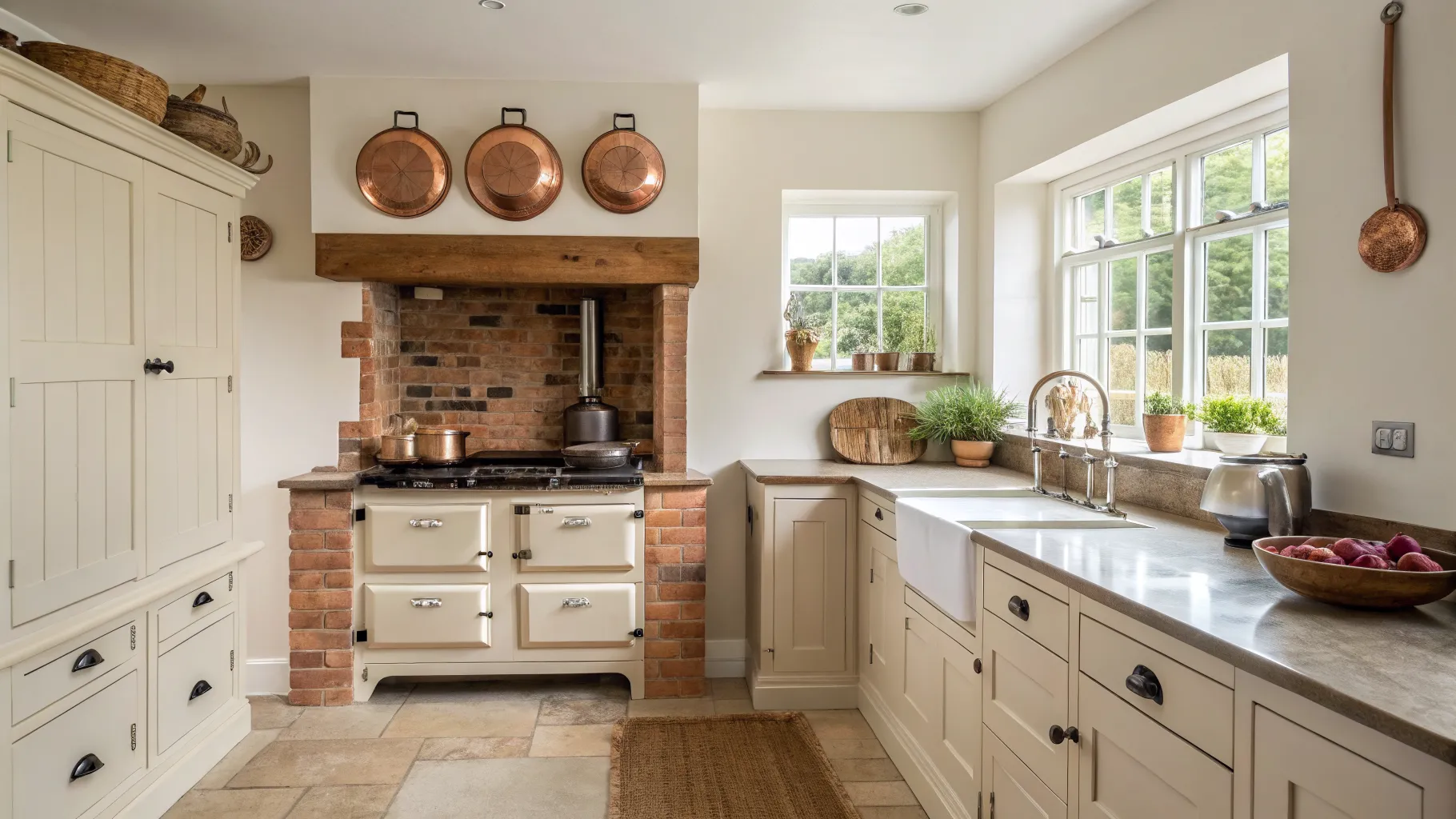
Cream is the safest choice in a cottage and, done properly, the least boring. The trick is to avoid magnolia by pairing a warm cream with something with backbone: a dark worktop, black ironmongery, or a stone floor. Our cottage and traditional kitchen ideas piece goes further on that balance.
Deep blues
Navy and inky blue remain strong, and they suit a country kitchen better than people expect, particularly with a cream range cooker. Farrow & Ball’s Hague Blue and Stiffkey Blue are the two that keep appearing. Blue reads cooler than green, so it is a better fit for a south or west-facing room than a north one.
Burgundy and warm reds
The genuinely new arrival. Burgundy, oxblood and terracotta-adjacent reds are appearing on island units and pantry cupboards as a saturated accent. In a country kitchen it works on a small run rather than everywhere: an island, a dresser, or the inside of a glazed cupboard.
Butter yellow
Soft yellows are back after a long absence, and they are the answer to a dark north-facing kitchen where you do not want to go dark. Keep it muted and chalky rather than primary.
The rules that stop it going wrong
Three colours, maximum. Units, walls, and one accent. A country kitchen already has a lot going on visually: exposed timber, a large cooker, open shelving, tiles. Adding a fourth colour is what tips it from characterful to chaotic.
Do not fight the cooker. A cream or black range is a large, permanent block of colour. Pick your palette around it, not despite it. Our range cooker buying guide covers how much visual weight different sizes carry.
Let the worktop lead. Oak and other warm timbers push you towards greens, creams and warm neutrals. Grey granite or quartz sits better with blues, cooler greens and crisp whites. A worktop is far more expensive to change than paint.
Two tone is the workhorse. Darker base units with lighter wall units, or a contrasting island, adds depth without commitment. It also solves a low-ceilinged cottage kitchen, where all-dark units close the room in.
Ceilings and woodwork are not automatically white. Brilliant white next to a soft historic colour looks like a mistake. Take the wall colour and use a lighter tint of it, or a warm off-white.
Where the colour actually goes
- All units one colour: calm, cohesive, and the safest choice for a small kitchen.
- Two-tone base and wall units: adds depth, grounds the room, and is currently the most popular arrangement in British kitchens.
- Coloured island only: a good way to use a bold shade without living inside it. Works only if the island is big enough to look deliberate.
- Painted dresser or pantry: the lowest-risk way to introduce burgundy, deep teal or a strong green.
- Colour on the walls, timber units left natural: underrated, and the most honestly rustic option.
A practical note on paint finish
Kitchen cabinetry needs a hard-wearing eggshell or a dedicated cabinet paint, not emulsion. Walls near a cooker and sink want a wipeable finish. Most premium British paint brands now publish washability and VOC information for each finish, and the British Coatings Federation is the industry body if you want to understand the labelling and safety standards behind those claims.
If you are painting existing units rather than buying new, preparation decides the outcome far more than the paint does. Degrease, sand, prime with an adhesion primer suited to the substrate, and accept that a rushed job on greasy doors will chip within months.
Frequently asked questions
What is the most popular kitchen colour in the UK right now? Green in its various depths, from soft sage through to near-black forest shades, has overtaken grey as the standard choice for painted cabinetry. Warm neutrals with earthy undertones sit alongside it, and navy remains strong for people who want a dark unit without going green.
What colour makes a small kitchen look bigger? Light, warm shades on the units with a similarly light wall colour, and minimal contrast between the two, since visible boundaries make a room read as smaller. A single darker accent, such as an island or a run of low units, adds depth without shrinking the space.
Should kitchen walls be lighter or darker than the units? Lighter, in most country kitchens, because it keeps the eye moving upwards and stops the room feeling top-heavy. The reverse can work in a large room with high ceilings, where dark walls above pale units create a cocooning effect.
What colour kitchen units go with oak worktops? Warm greens, soft sage, cream, mushroom and warm off-whites all sit comfortably with oak. Cool greys and stark blue-whites tend to clash with the timber’s orange undertone and make the worktop look yellow.
Are grey kitchens out of date? Not unusable, but no longer the default, and cool-toned greys in particular now date a kitchen quickly. If you have a grey kitchen you like, warming the walls and swapping ironmongery to brass updates it far more cheaply than repainting the units, as covered in our grey kitchen ideas guide.
How many colours should a kitchen have? Three at most: one for the units, one for the walls, and one accent carried through ironmongery, tiles or a single painted item. Beyond that a room with as much visual texture as a country kitchen starts to look unresolved.