Range Cooker Buying Guides
Range Cooker Buying Guide: Sizes, Fuels and What to Check Before You Order

By the Hill & May team
Updated 2026
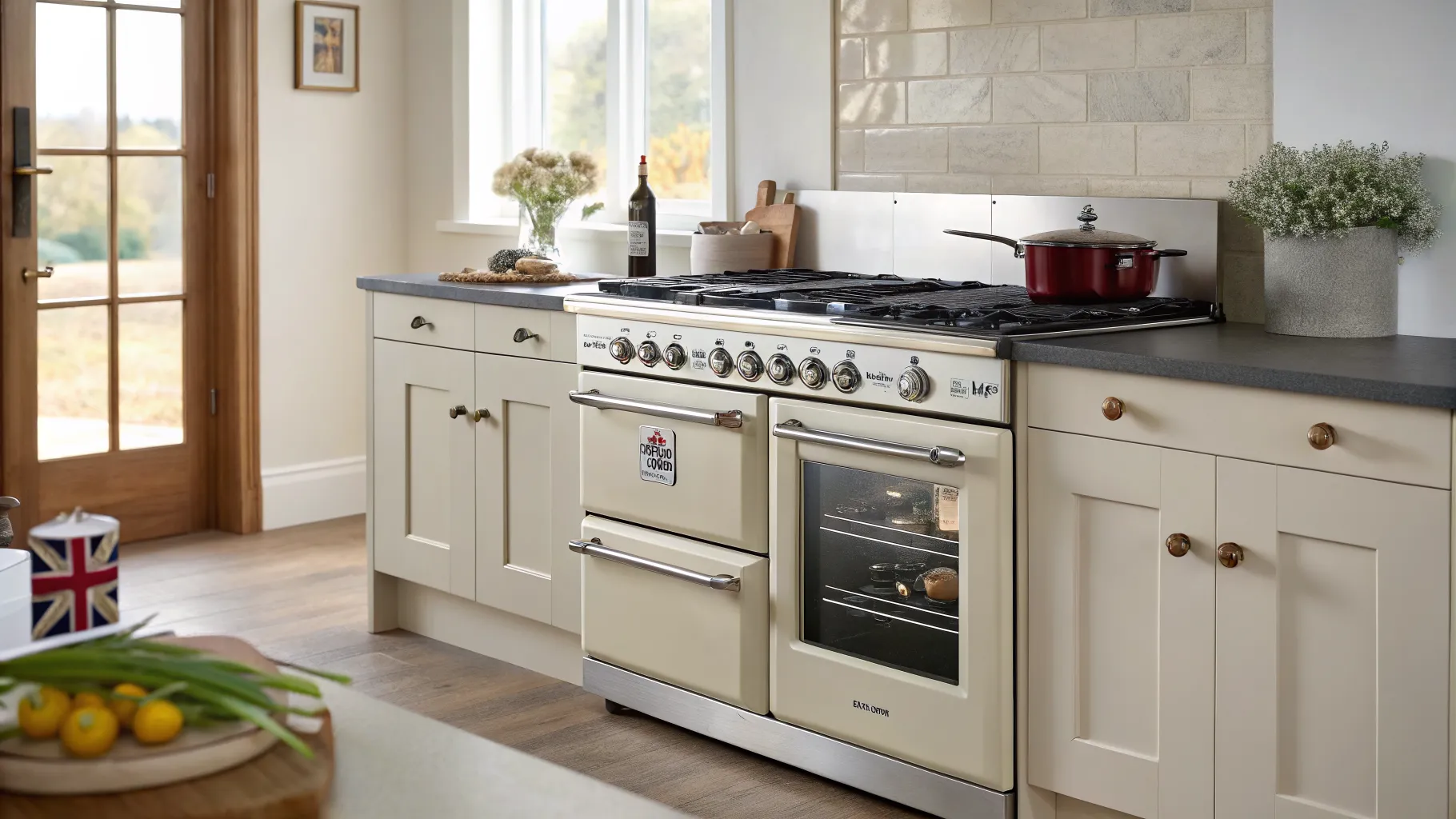
Range cookers sit in a different buying category from a 60cm freestanding oven. They are wider, heavier, draw more power, and most of them legally need a registered engineer to connect. That means the decisions you make before you order, the width, the fuel, and the supply it will plug into, matter more than the colour or the brand badge. This guide walks through sizes, fuel types, real running costs, what actually fits inside the oven, and the installation checks that catch people out after the cooker has already been delivered.
Start with the gap, not the cooker
The single most common buyer question is whether a given cooker will fit. Range cookers are built to slot between kitchen units, so the number that matters is the gap between your cabinets, not the cooker’s own width.
Mainstream widths are 90cm, 100cm, 110cm and 120cm, with 150cm at the very top end. A 60cm “mini” range cooker exists but is the exception, not the norm. The 90cm is the smallest mainstream size and the most popular; the 110cm is the largest mainstream size, offering up to roughly seven or eight hob zones plus multiple ovens and a grill.
| Width | Typical hob zones | Best for |
|---|---|---|
| 90cm | around 5 | smaller kitchens, the popular default |
| 100cm | 5 to 7 | a middle step up in oven space |
| 110cm | up to 7 to 8 | big families, batch cooking, twin full-size ovens |
| 120cm and up | 8 plus | open-plan kitchens with the run to spare |
A practical fit rule: cut the cabinet gap about 5mm wider than the cooker. A 1000mm gap takes a cooker around 995mm wide, which gives you a little wiggle room to slide it in and level it. Modern range cookers are well insulated, so side clearance is small, commonly around 2.5mm each side, up to about 10mm where the cabinetry needs heat protection. Models with handles or towel rails on the side, such as the Stoves Richmond, need more room than the bare carcass suggests, so check the manual for that specific model before you commit to a tight gap.
Two more reality checks that forums raise constantly and buying guides skip:
- Range cookers are heavy and usually a two-person lift. Measure your doorways, hallway turns and the kitchen entrance, not just the final gap.
- Confirm whether the supplier will actually disconnect and remove your old appliance on delivery (more on that below). It is not automatic.
For a deeper look at matching width to your kitchen, see what size range cooker do I need.
The four fuel types, explained properly
Fuel choice drives both how the cooker behaves and how much it costs to run.
- Dual fuel pairs a gas hob with an electric (usually fan) oven. It is the most popular type on sale because it gives you the instant, visible control of a gas flame on the hob with the even, steady heat of a fan oven for baking and roasting.
- Induction uses an electromagnetic field to heat the pan directly rather than the surface underneath it. It is the fastest and most energy-efficient hob type, the glass surface stays comparatively cool, and it needs ferrous (magnetic) cookware to work.
- Ceramic electric is a flat radiant surface that heats the glass, which then heats the pan. It is easy to wipe clean, cheaper than induction, and works with any pan.
- LPG runs on bottled propane or butane and burns hotter than mains gas. Many gas models are LPG-convertible with a jet kit, useful if you are off the mains gas grid.
Induction cookware: do the magnet test
Induction only works with pans that a magnet sticks to. If a fridge magnet grips the base firmly, the pan will work; cast iron and most stainless steel pass, while aluminium, copper and some thin stainless do not. Match the pan base to the zone size as well, since a small pan on a large zone wastes energy and a pan that overhangs a small zone heats unevenly. Budget for new pans if your current set fails the test, because that cost is easy to forget when you compare an induction range against a dual-fuel one.
What a range cooker actually costs to run
Running cost is rate-dependent, so treat any annual figure as a snapshot tied to current unit prices. Which? estimates running costs using their stated July to September 2026 rates of 26.11p per kWh for electricity and 7.33p per kWh for gas.
| Fuel type | Estimated running cost per year | Source |
|---|---|---|
| Gas range cooker | around £26 | Which? (rates above) |
| Dual fuel or all-electric | around £66 | Which? (rates above) |
A second trade source lands in the same place, roughly £27 a year for gas and £61 for dual or electric, so the shape is consistent: electricity costs more than double what gas costs to run a range cooker. As a rough planning figure at recent unit rates, budget around £25 to £30 a year for gas and £60 to £70 a year for dual fuel or all-electric, and revisit it whenever the energy price cap changes.
For a more precise estimate based on your own tariff and how much you cook, try the range cooker running cost calculator.
Total cost of ownership, not just the running cost
Most buying guides quote only the running cost and stop there. The bigger surprises hide in installation. Plan for all of these before you order:
- The cooker itself, which spans a wide range from entry-level models up to premium AGA-tier ranges.
- A Gas Safe install for any gas or dual-fuel model (a separate engineer fee).
- A possible electrical circuit upgrade, which for an all-electric or induction range can mean a 45A cooker circuit fitted by an electrician.
- Old-appliance disconnection and removal, which only happens under specific conditions covered below.
A cheaper all-electric range can end up costing more overall than a dual-fuel one if your kitchen needs a new 45A circuit run to it.
Oven configuration and the capacity you actually get
A single-cavity oven is typically around 100 to 120 litres, enough for a 6kg to 9kg turkey. A twin or dual cavity gives you one larger oven and one smaller one, so you can run two temperatures at once, which is the reason batch bakers and big families step up to a 100cm or 110cm. As a baseline, around 60 litres of usable space suits a family of four.
The honesty point that almost no other guide makes: usable internal space is substantially less than the manufacturer’s stated gross capacity. The litres on the spec sheet measure the empty cavity, but shelves, runners and the space you need to slide a tray in and out all eat into it. When you compare models, look at how many full-width shelves there are and the clearance between them, not just the headline litre figure. If you regularly cook a large roast or bake on multiple trays, prioritise a tall main cavity over a big-sounding total.
Catalytic versus pyrolytic cleaning
| Cleaning type | How it works |
|---|---|
| Catalytic | Specially coated liners absorb and break down grease at normal cooking temperatures, so the oven cleans gradually as you use it. |
| Pyrolytic | The oven heats to around 400°C to 500°C to incinerate residue to a fine ash you wipe out afterwards. |
Pyrolytic is the more thorough self-clean but uses energy to run the high-temperature cycle. Catalytic needs less of your attention but does not tackle heavy spills the way a pyrolytic burn-off does.
What to check before you order: installation and supply
This is where most of the after-the-fact problems live, and it splits by fuel.
Gas and dual fuel: you need a Gas Safe engineer
Any gas or dual-fuel range cooker must be installed by a Gas Safe registered engineer, including fitting a new or replacement bayonet connection. This is a legal requirement, not a recommendation. You can check an engineer’s registration on the Gas Safe Register. Book the install before the cooker arrives so you are not left with an unusable appliance in the kitchen.
Electrical supply: the 13A, 32A and 45A question
This is the trap that catches buyers out, and almost no competing guide spells it out. A range cooker’s electrical needs depend on its power draw:
| Load | Typical supply needed |
|---|---|
| Under about 2.99kW | a standard 13A plug or fused outlet can be enough |
| Over 3kW | a 32A breaker with 6mm cable |
| All-electric or induction ranges | often 10mm flex to a 45A double-pole switch, sometimes higher |
A dual-fuel cooker typically wires via 6mm heat-resistant flex to a 32A double-pole switch, which must be accessible and never positioned directly above the hob. An all-electric or induction 110 is the one that surprises people: it can need a 45A circuit and an electrician, not a quick plug-in. If you are rewiring the kitchen anyway, the future-proof move is to fit a 45A cooker circuit now, so you can swap to all-electric or induction later without pulling new cable.
Delivery and old-appliance removal
Disconnection and removal of your existing cooker is only done if you pre-book it and the engineer judges that the existing connection meets Gas Safe standards. If the old connection is non-compliant, they can decline to touch it. Combine that with the two-person lift and the doorway access check above, and you can see why “what to check before you order” is mostly about logistics, not features.
How long range cookers last
Build quality and maintenance matter more than the badge, but as a planning figure, gas ranges tend to last around 15 to 20 years, while electric ranges and ovens run around 13 to 16 years with proper maintenance. Factor that lifespan into the total cost: a more expensive, better-built range spread over 18 years can be cheaper per year than a budget model you replace twice.
A note on energy labels
An “A rated” range cooker is not directly comparable to an A-rated fridge. Ovens still sit on the older A+++ to D label scale and have not yet migrated to the new A to G scale that fridges, washers and dishwashers moved to in 2021. Ecodesign for ovens and hobs is governed by EU Regulation 66/2014; post-Brexit Great Britain uses its own equivalent labelling, but the A to G migration for ovens is still pending. You can see the current framework on the EU’s ecodesign and energy labelling page for domestic ovens, hobs and range hoods. The practical takeaway: judge ovens against each other on the oven scale, not against your fridge.
Two benchmark models to anchor your shortlist
These two 110cm models illustrate the dual-fuel versus induction split with verified specifications.
Dual-fuel benchmark: Rangemaster Classic Deluxe 110
| Feature | Detail |
|---|---|
| Width | 110cm |
| Ovens | Main 80L multifunction (8 functions, DUO mode) plus a second full-size 80L fan oven, 160L combined |
| Hob | 5 gas burners (including a 3.5kW multi-ring) plus a 2-zone ceramic Multi-Zone with griddle plate and wok cradle |
| Grill | 2.3kW Flexi-Grill on telescopic runners, full and half settings |
| Other | Handyrack, proving drawer, catalytic liners in both ovens |
| Dimensions | 905 (H) x 1092 (W) x 608 (D) mm |
| Warranty | 2-year parts and labour |
Full specifications are on the Rangemaster Classic Deluxe collection page.
Induction benchmark: Stoves Richmond Deluxe S1100EI
| Feature | Detail |
|---|---|
| Width | 110cm |
| Hob | 5-zone induction with bridgeable zones |
| Ovens | QuadOven setup, four ovens including a dedicated slow-cook cavity and a multifunction main oven |
| Total capacity | around 196L combined across the four ovens |
| Dimensions | around 900-930 (H) x 1096 (W) x 600 (D) mm, excluding handles and knobs |
Specifications are on the Stoves Richmond Deluxe S1100EI page.
Other real models worth shortlisting include the Rangemaster Professional Deluxe 100, the Rangemaster Leckford Deluxe, the value-tier Stoves Sterling Deluxe 90, the Stoves Richmond Colour Boutique range, the Smeg Victoria, and the premium AGA Masterchef Deluxe 110 Induction. Verify the exact litres and zone count on each model’s product page before you rely on the numbers, since only the two benchmarks above are spec-checked here.
Which range cooker suits your situation
| If you are | Lean towards | Why |
|---|---|---|
| A keen cook who loves a gas flame | Dual fuel (e.g. Rangemaster Classic Deluxe 110) | Instant hob control plus even fan-oven baking |
| Fitting out an all-electric new build | Induction (e.g. Stoves Richmond Deluxe S1100EI) | No gas supply needed, fastest and most efficient hob |
| A batch baker or large family | A 100cm or 110cm twin-cavity | Two ovens at two temperatures, more usable shelf space |
| Watching running costs closely | A gas hob (dual fuel) | Gas costs less than half what electricity does to run |
| Off the mains gas grid | An LPG-convertible model | Runs on bottled gas with the right jet kit |
For wider comparisons, see our best range cookers 2026 roundup, AGA vs Rangemaster if you are weighing a premium range against a mainstream one, and AGA running costs per year if an always-on range is on your list.
Frequently asked questions
What width range cooker do I need? Measure the gap between your kitchen units first, then choose a cooker about 5mm narrower so it slides in. The mainstream widths are 90cm, 100cm, 110cm and 120cm. A 90cm is the popular default for most kitchens, while a 110cm gives you up to seven or eight hob zones and twin full-size ovens for big families and batch cooking.
Is dual fuel better than induction? Neither is universally better; they suit different priorities. Dual fuel gives you a responsive gas hob with an even electric fan oven and is the most popular type on sale. Induction is the fastest and most energy-efficient hob, the surface stays cooler, and it works well in all-electric kitchens, but it needs magnetic cookware and an all-electric range may require a 45A circuit fitted by an electrician.
How much does a range cooker cost to run per year? At recent unit rates, budget roughly £25 to £30 a year for a gas range cooker and around £60 to £70 a year for a dual-fuel or all-electric one. Which? estimates about £26 for gas and £66 for electric using their July to September 2026 rates of 26.11p per kWh for electricity and 7.33p per kWh for gas. Because these track the energy price cap, recheck the figures whenever rates change.
Do I need a Gas Safe engineer to install a gas range cooker? Yes. Any gas or dual-fuel range cooker must be installed by a Gas Safe registered engineer, which includes fitting the bayonet connection. You can confirm an engineer is registered on the Gas Safe Register website. Book the install before the cooker is delivered.
What electrical supply does a range cooker need? It depends on the power draw. A load under about 2.99kW can run off a standard 13A plug, anything over 3kW needs a 32A breaker with 6mm cable, and all-electric or induction ranges often need 10mm flex to a 45A double-pole switch. If you are rewiring, fit a 45A cooker circuit now to future-proof for an all-electric range later.
Will the shop disconnect and remove my old cooker on delivery? Only if you pre-book that service and the engineer judges your existing connection meets Gas Safe standards. If the old connection is non-compliant, they can decline to disconnect it. Range cookers are a heavy two-person lift, so also confirm doorway and hallway access before the delivery date.
How long do range cookers last? With proper maintenance, gas ranges typically last around 15 to 20 years and electric ranges and ovens around 13 to 16 years. A better-built range spread over a longer lifespan can work out cheaper per year than a budget model you replace sooner.