Aga Cookers
Is an Aga Worth It? £25 to £30 a Week and Who It Suits

By the Hill & May team
Updated 2026
Is an Aga worth it? For a household that cooks most days, lives in the kitchen and would otherwise heat it, yes, and owners in that position rarely regret it. For anyone who wants a cooker to be quick, precise and cheap to run, no: a good conventional range cooker does those jobs better for a fraction of the cost. The honest answer turns on four numbers and one question about how you live, and this page sets them out.
The numbers below use the October to December 2026 energy price cap of 26.32p per kWh for electricity and AGA’s own published consumption figures, checked on 27 October 2026.
The short answer
| AGA cast-iron cooker | Conventional range cooker | |
|---|---|---|
| Running cost | About £25 to £30 a week by AGA’s figures; £1,026 to £1,954 a year if left on | About £76 to £130 a year |
| Buying price | Several times a good conventional range | The baseline |
| Servicing | None on current electric models | None for electric; a periodic gas safety check is advised if gas |
| Kitchen warmth | Yes, when the cast iron is on | Negligible |
| Speed | Hotplates 10 to 12 minutes; cast ovens about an hour from cold | Minutes |
| Temperature control | Fixed oven temperatures (selectable on newer models) | Thermostat dial |
| Lifespan | Cast iron lasts decades; cookers are routinely reconditioned and resold | Typically replaced, not rebuilt |
The running cost gap is the one that decides it for most people. It is not a difference of degree. A cast-iron cooker left running costs roughly ten to twenty-five times as much a year as an ordinary range, and you only get value from that if the heat is doing a job you would otherwise pay for.
What an Aga actually costs to run
AGA’s running costs page puts today’s cast-iron cookers at around £25 to £30 a week at 26.32p per kWh, and says many homes spend less. Which?, using the same price cap, gives £19.45 to £27.64 a week for three-oven electric models. The top of that range matches AGA’s own consumption figure for the Classic on its economy setting, 105 kWh a week.
Over a year, that is where the money goes:
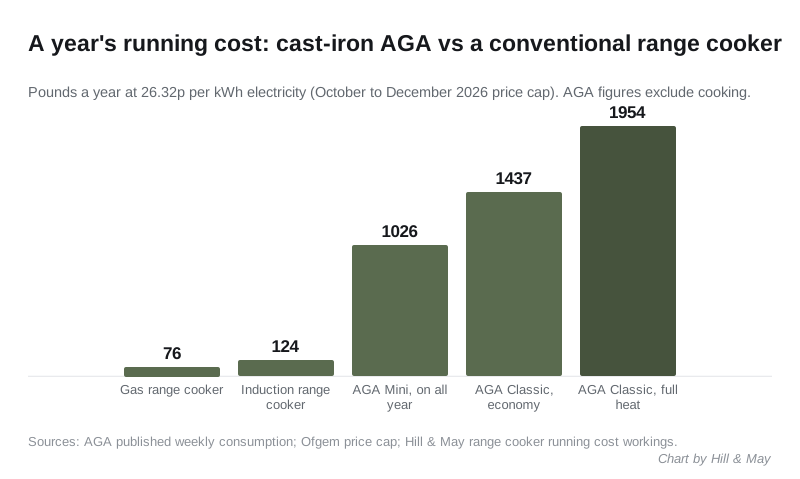
- AGA Classic, three ovens on economy, all year: 105 kWh a week, about £1,437 a year.
- AGA Classic at full temperature, all year: 142.8 kWh a week, about £1,954 a year.
- AGA Mini, both ovens on continuously: 75 kWh a week, about £1,026 a year.
Those figures exclude cooking; they are the cost of keeping the cast iron hot. A conventional 110cm range cooker costs about £76 to £130 a year in total: about £76 for gas and £124 for induction on our worked figures. Our range cooker running costs page shows the working for both.
The newer controllable models change this. On the AGA Signature (the former eR7) and the Compact (the former eR3), every oven and hotplate switches independently, and AGA says turning hotplates off when they are not in use can cut running costs by more than half against older cookers. Run one oven for a Sunday roast and nothing on a summer weekday and the bill follows how much you cook, not the calendar. Our Aga running costs by model breaks that down oven by oven.
What the money buys
People who say an Aga is worth it are usually talking about three things, and they are real.
The cooking. Heavy cast-iron ovens store heat and radiate it back from every surface, rather than blowing hot air around. Roasts stay moist, bread gets a good crust, and the simmering oven is a slow cooker that never needs switching on. Several dishes can cook at once at different temperatures. AGA says the radiant heat “locks in flavour and moisture”, and Which? notes the ovens are generally larger than those on conventional range cookers.
The warmth. An always-on cast-iron cooker heats the kitchen all winter, dries washing on the rail and keeps the room the place everyone gathers. In an old farmhouse kitchen with thick walls and little other heating, that heat is not wasted: you would be paying to heat the room some other way. This is the strongest financial case for an Aga, and it only applies to some kitchens.
The life of the thing. Which? calls Agas “known for their durability and reliability”. The castings last decades, there is an established trade in reconditioned Agas, and AGA runs a certified re-enamelling service for cast-iron cookers made after 1974. A conventional range cooker is usually replaced when it fails. An Aga is usually rebuilt.
What you give up
- Speed. AGA’s user guide gives about an hour for the cast ovens on a Signature to reach temperature from cold. If you switch it off to save money, you have to plan supper an hour ahead. If you leave it on so it is ready, you are back to the higher running cost.
- Control. Which? lists “limited temperature control” as a drawback against conventional range cookers. Each oven on a traditional Aga runs at its own fixed temperature; you cook by choosing the oven and the shelf, not a dial. Newer models offer selectable temperatures, but it is still a different way of cooking.
- A learning curve. Which? also notes that Agas “operate differently from conventional cookers”. Expect a few weeks of burnt edges while you learn how hot the roasting oven really is. Our Aga roasting time calculator helps with the timings.
- Summer. An always-on cooker in July heats a kitchen that does not need it. Owners of traditional Agas often switch off for the summer and use a second cooker, which is another appliance to buy and house.
- Installation. A cast-iron Aga is heavy. Older gas and oil models need a flue and, for oil, a tank that meets the rules in our oil tank regulations page. Current electric models need no external flue or concrete plinth, which widens where one can go, but you still need the right electrical supply.
Who an Aga is worth it for
- You cook from scratch most days, especially roasts, bakes and slow cooking, and you would use more than one oven at a time.
- The kitchen is the heart of the house and you would otherwise heat it, particularly in an older rural property.
- You want one cooker for decades, and like that it can be reconditioned rather than scrapped.
- You plan meals, so an hour’s warm-up on a controllable model is not a problem.
- You value the look and the way of life, and are buying it partly for that. There is nothing wrong with that, as long as you price it honestly.
Who should buy something else
- You mostly cook quick weekday meals on the hob. An induction range cooker will be faster and far cheaper; see our induction range cooker guide.
- Your kitchen is already warm, in a well-insulated modern house or a flat. The heat an always-on Aga gives off becomes a cost, not a benefit.
- You want precise baking temperatures and a fan oven you can set to 180 degrees.
- The budget is tight. The gap between an Aga and a very good conventional range cooker buys a lot of other kitchen.
If you are torn, the two common middle routes are a controllable electric AGA, which keeps the cast-iron cooking without the always-on bill, and a conventional range cooker with a large oven, which gives you the look and capacity without the cast iron. Our AGA vs Rangemaster comparison and the electric vs traditional Aga page go into each.
Run the numbers for your own kitchen
The cost question is easy to get wrong in both directions, because the price difference is paid once and the running cost every week for twenty years. Our Aga vs conventional cooker lifetime cost calculator puts both side by side over ten years and more, with your own tariff. If you are on a time-of-use tariff, read about Economy 7 rates for an electric Aga first: off-peak is not always the cheaper route.
For AGA’s own figures, see its running costs page. For an independent view, Which? publishes a guide on whether you should buy an Aga.
Frequently asked questions
Is an Aga worth the money? If you cook most days, use more than one oven at once and would otherwise heat your kitchen, yes. If you want quick, precise and cheap cooking, a conventional range cooker is better value: about £76 to £130 a year to run against roughly £25 to £30 a week for a cast-iron AGA.
How much does an Aga cost to run per week? AGA puts its current cast-iron cookers at about £25 to £30 a week at the October 2026 electricity price of 26.32p per kWh. Which? gives £19.45 to £27.64 a week for three-oven electric models. Switching ovens and hotplates off on a controllable model cuts that sharply.
Do Agas need servicing? Current electric models (Signature, Classic, Compact and Mini) need no regular servicing, according to AGA. Traditional gas Agas need a service every 12 months and oil Agas every 6 months. See our page on how often an Aga should be serviced.
How long does an Aga last? The cast-iron body lasts decades with care, which is why reconditioned Agas are common. Wear parts such as elements, thermostats and door seals are replaced along the way, and AGA re-enamels cast-iron cookers made after 1974.
Can you turn an Aga off? On today’s controllable models, yes: ovens and hotplates switch on and off independently. On a traditional always-on Aga you can turn it off, but it takes many hours to heat back up, so most owners only do it for the summer.
Is an Aga hard to cook on? It is different rather than hard. Each oven runs at its own temperature and you move food between ovens instead of turning a dial. Give it a few weeks before you judge it.