Aga, Rayburn and Heat-Storage Cookers
Oil Tank Regulations for an Aga: 1.8m, 760mm, 2,500 Litres

By the Hill & May team
Updated 2026
The oil tank regulations for a domestic oil-fired Aga or Rayburn in England come down to four numbers: keep the tank at least 1.8m from the house, at least 760mm from a boundary fence, put it in a bund if it holds more than 2,500 litres, and stay at or under 3,500 litres to remain inside the domestic rules. Fall short on a distance and the answer is a fire wall, not a refusal. These rules come from Building Regulations Approved Document J, and they apply when a tank is new or replaced, not to one that has sat quietly behind the log store since 1990.
An oil-fired two-oven Aga burns roughly 40 litres of kerosene a week, about 2,080 litres a year (our Aga running costs page shows the sum). That is why the tank matters to cooker owners in a way it does not to someone with a boiler that sits idle all summer: an Aga on tickover drinks year round, so the tank tends to be bigger and gets filled more often.
Which rules apply to a domestic oil tank
There are two separate sets of rules, and the tank’s capacity decides which one you are under.
| Tank capacity | Rules that apply in England |
|---|---|
| 3,500 litres or less, at a house | Building Regulations (Approved Document J, requirements J6 and J7) |
| 3,501 litres or more, at a house | The business rules: Control of Pollution (Oil Storage) (England) Regulations 2001 |
| 201 litres or more, at a business | The business rules, whatever the size of the house next door |
The government’s guide to storing oil at your home puts it plainly: you must meet building regulations if you have a new or replacement oil storage container installed at your home in England, “for example to fuel your cooker or central heating”, and if the container can hold 3,501 litres or more you must follow the regulations for businesses instead. Approved Document J says the same from the other side: the 2001 pollution regulations do not apply to oil stored at a private dwelling where the tank is 3,500 litres or less.
For almost every Aga or Rayburn kitchen, then, the domestic rules are the ones that count. A farmhouse is treated as a home for this purpose when the oil heats the farmhouse, but if the same tank also fuels a business, such as vehicles you hire out, the business rules apply.
Wales, Scotland and Northern Ireland each have their own versions. The figures below are England’s. If you live elsewhere, your installer will work to the local equivalent and the numbers are similar but not identical.
How far the tank must be from the house, the fence and the flue
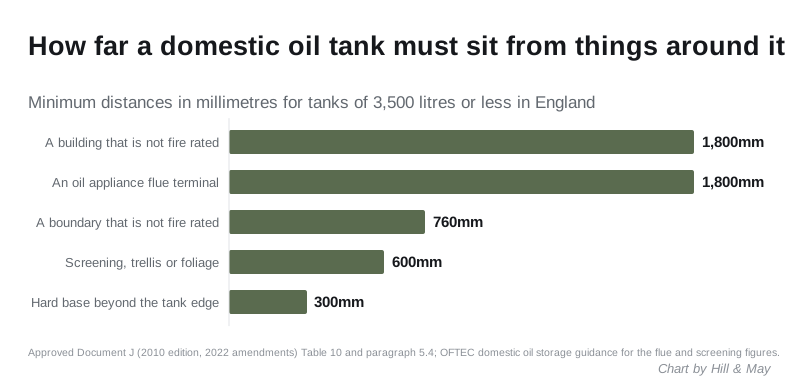
Table 10 of Approved Document J sets the fire separation for heating oil tanks of 3,500 litres or less:
- At least 1,800mm from any part of a building, and at least 760mm from a boundary: no further fire protection needed.
- Closer than 1,800mm to the house: either make the wall within 1,800mm of the tank imperforate with at least 30 minutes’ fire resistance (small openings such as air bricks are excluded), or build a fire wall between the tank and the building. In both cases, eaves within 1,800mm of the tank, and for 300mm beyond each side of it, need 30 minutes’ fire resistance to external fire and non-combustible cladding.
- Closer than 760mm to a boundary: put a fire wall between the tank and the boundary, or use a boundary wall with at least 30 minutes’ fire resistance from either side. It must stand at least 300mm higher and wider than the top and sides of the tank.
A fire wall here means an imperforate, non-combustible wall or screen: a masonry wall or a fire-rated composite panel. A larch-lap panel is a fence, not a fire wall, which is why the 760mm figure catches so many garden-edge tanks.
OFTEC, the oil heating trade body, adds two figures installers work to that are not in Table 10: keep the tank at least 1.8m from the flue terminal of any oil-fired appliance, and at least 600mm from screening that is not part of the boundary, such as trellis or shrubs. That flue figure is the one Aga owners trip over. A Rayburn or oil Aga with a low-level balanced flue on the back wall can rule out the obvious spot for the tank, right outside the kitchen.
The base. Approved Document J also wants a hard surface under the tank so a fire cannot creep in through dry grass: concrete, or paving slabs at least 42mm thick, reaching at least 300mm beyond the tank (or beyond its outer skin if it is a bunded tank).
When the tank needs a bund
A bund is a second skin or a walled enclosure that catches oil if the inner tank fails. It must hold at least 110% of the tank’s capacity and be impermeable to oil and water. You need one if the tank holds more than 2,500 litres, or if it sits:
- within 10m of a stream, river, pond, ditch or the sea;
- where a spill could run into an open drain or a loose-fitting manhole cover;
- within 50m of a well, borehole or spring;
- where spilled oil could run across hard ground to any of those waters;
- in the inner zone (Zone 1) of a groundwater Source Protection Zone;
- where the vent pipe cannot be seen from the point where the tanker fills it.
The installer makes this call through a risk assessment. In practice, nearly every new domestic tank sold now is integrally bunded (a tank within a tank), and plenty of rural houses tick at least one box on that list: a ditch at the bottom of the garden, a private water supply, or a driveway too far for the driver to see the vent. If you are replacing an old single-skin tank, assume the new one will be bunded and price accordingly.
The 2,500 litre line also shapes what size of tank makes sense. A 2,500 litre tank holds a little over a year of fuel for a two-oven Aga left on, which lets you buy once a year when heating oil prices dip. Go bigger and the bund becomes compulsory regardless of where the tank sits; go past 3,500 litres and you move into the business regulations and lose permitted development rights, below.
Do you need planning permission for an oil tank?
Usually not. A domestic fuel tank is permitted development in England, and the Planning Portal’s conditions are:
- not more than 3,500 litres;
- not forward of the principal elevation of the original house;
- no more than 3m high overall, and no more than 2.5m within 2m of a boundary;
- not at the side of the house on designated land (conservation areas, National Parks, National Landscapes, the Broads, World Heritage Sites).
Any container within the curtilage of a listed building needs planning permission. Plenty of houses with old Agas are listed, so check before the tank is ordered rather than after it arrives.
Who can fit it, and the paperwork you need
Fitting a new or replacement tank is building work under the regulations. The simple route is an installer registered with a competent person scheme, which for oil means OFTEC or an equivalent body. They self-certify the job, deal with building control, and leave you a compliance certificate.
If you use someone who is not registered, you have to give your council a building notice and pay for building control to inspect the work. Skip both and you will not have the certificate a buyer’s solicitor asks for when you sell. The government guide is blunt: the installer can be fined for non-compliant work, but you are also responsible, and the council can make you pay to put it right.
Two smaller things the installer should leave behind:
- The oil care label. Every tank must carry a sticker in a prominent place saying what to do if it leaks, with the Environment Agency’s emergency number. If yours has faded away, Oil Care will send a new one.
- A fire valve. Approved Document J’s route to compliance includes fire-resistant fuel pipework and a proprietary fire valve on the supply line, which shuts the oil off if there is a fire at the cooker end.
Looking after the tank once it is in
The government recommends an annual inspection of the tank by someone registered with a competent person scheme, and a monthly look yourself for damage, splits, weeping seams or oil in the bund. It is sensible to book the tank check alongside the cooker’s own service; our Aga servicing intervals page covers how often an oil Aga’s burner needs attention. Oil appliances also need a carbon monoxide alarm when installed or replaced, which our carbon monoxide alarm rules page explains.
If oil does leak, stop it spreading if you safely can, follow the instructions on the tank label, and call your insurer, your oil supplier and the Environment Agency rather than trying to clean it up yourself. Oil that reaches a watercourse can lead to legal action against the owner, and you are responsible for the tank, not the company that fills it.
Weighing up oil against bottled or bulk gas for a new range cooker? Our LPG versus oil off-grid comparison covers the running cost gap and who owns the tank.
Frequently asked questions
Can I keep my old oil tank when I fit a new Aga? Yes, if it is sound. The building regulations bite on new and replacement tanks, not on an existing one that still works. Have it inspected at the same time as the cooker install: an installer will tell you if it is near the end of its life, and a cooker change is the cheapest moment to replace it.
How close can an oil tank be to a house? 1.8m with no extra protection. Closer than that, the wall within 1.8m of the tank must be imperforate with 30 minutes’ fire resistance, or a fire wall must stand between them, and the eaves above need fire-resistant, non-combustible treatment too.
How close can an oil tank be to a fence? 760mm from a boundary that is not fire rated. Any closer needs a fire wall, or a fire-rated boundary wall, at least 300mm higher and wider than the tank.
What size oil tank does a domestic house need for an Aga? A two-oven oil Aga left on uses about 2,080 litres a year, so a tank of around 2,500 litres covers a year with one fill. Above 2,500 litres a bund is compulsory, and above 3,500 litres you leave the domestic regulations and permitted development behind.
Do domestic oil tanks have to be bunded? Only above 2,500 litres or where the risk assessment finds a pollution risk, such as nearby water, an open drain or a vent the tanker driver cannot see. Most new tanks are bunded anyway.
Do oil tank regulations apply in Scotland and Wales? Each nation has its own rules. Wales and Scotland have their own building regulations and oil storage rules, and Northern Ireland has its own too. The distances are broadly similar, but use an installer who works to your nation’s version.
Sources
- GOV.UK, Storing oil at your home or business, read 22 October 2026.
- Approved Document J, Combustion appliances and fuel storage systems, 2010 edition incorporating 2010, 2013 and 2022 amendments: paragraphs 5.2 to 5.12 and Table 10.
- Planning Portal, fuel tanks: permitted development conditions, read 22 October 2026.
- OFTEC domestic oil storage guidance, for the flue terminal and screening distances.