Aga, Rayburn and Heat-Storage Cookers
AGA vs Rayburn: One Cooks, One Also Runs Your Radiators

By the Hill & May team
Updated 2026
AGA vs Rayburn comes down to one question: do you want a cooker, or a cooker that is also your boiler? Both are cast-iron heat storage cookers made by the same company, and both cook with steady radiant heat from heavy iron ovens. But a new AGA is almost always electric and only cooks, while every current Rayburn burns oil or gas, heats your hot water, and in most models runs your central heating as well.
That single difference decides everything else: the fuel, the flue, the engineer, the servicing, and what the bill is really paying for. Every model detail below comes from AGA’s own product pages, checked on 20 November 2026.
AGA vs Rayburn at a glance
| AGA Classic 100 | AGA Rayburn (current range) | |
|---|---|---|
| What it does | Cooks; warms the kitchen as a side effect | Cooks, heats hot water, and in most models runs central heating |
| Fuel | Electric | Oil (some HVO-ready), natural gas or LPG |
| Ovens | 3 cast-iron ovens: roasting, baking, simmering | 2 cast-iron ovens: a main oven and a lower or warming oven |
| Hotplates | 2 round hotplates, switched on when needed | One large hotplate, 5 to 6 pans |
| Flue | Not needed | Needed |
| Width x depth | 987 x 698mm | 840 to 995mm wide, 542mm deep (Heatranger 611mm) |
| Weight | 444kg | 305 to 420kg |
| Routine servicing | None on current electric models | Once or twice a year, depending on model |
| Connections | Electricity only | Fuel supply, flue, hot water and heating pipework; OFTEC engineer for oil, Gas Safe for gas |
AGA’s own blog says virtually every new AGA cooker is now all-electric. The Rayburn is where AGA keeps the fuel-burning, boiler-in-a-cooker tradition going.
How they cook
An AGA has more ovens and set temperatures. The AGA Classic 100 has three heat-storage ovens at preset temperatures: a hot roasting oven, a moderate baking oven and a low simmering oven. You cook by choosing the oven and the shelf rather than turning a dial. AGA gives it four settings, including a low slumber mode and a higher heat setting, and its two round hotplates heat up in 10 to 12 minutes and can be switched on only when needed. Cast-iron AGAs in the Signature and Compact families control each oven separately; our AGA eR7 review and AGA eR3 review cover those.
A Rayburn has fewer ovens and one big hotplate. Every current Rayburn has two cast-iron ovens. The 300 Series pairs a main cooking oven with a large warming oven. The hotplate is a single wide cast-iron plate that is hotter over the burner and cooler towards the edge, so you slide pans across it to control the heat, much as you move food between AGA ovens. AGA says the 400 Series hotplate takes up to six saucepans, and the 300 Series and Heatranger up to five.
| Model | Ovens | Hotplate (width x depth) | Pans on the hotplate |
|---|---|---|---|
| AGA Classic 100 | 3 | Two round hotplates | Not stated |
| Rayburn 300 Series (308K) | 2 | 543 x 273mm | Up to 5 |
| Rayburn 400 Series | 2 | 543 x 197mm | Up to 6 |
| Rayburn 600 Series (680) | 2 | 600 x 354mm | Not stated |
| Rayburn Heatranger 80K | 2 | 550 x 323mm | Up to 5 |
For a big household that cooks several things at once, three ovens are the stronger case for an AGA. For a cook who does most work on top, the Rayburn’s single big plate is often easier than two round hotplates.
Heating and hot water: the real difference
An AGA warms the kitchen through its cast iron and does nothing for the rest of the house. A Rayburn has a boiler built in:
| Rayburn model | Fuel | Heats | Boiler output |
|---|---|---|---|
| 300 Series (308K) | Oil | Hot water only, 140 litre storage | 2.3kW |
| 400 Series | Natural gas or LPG | Hot water and central heating, up to 16 radiators | 17.6 to 23.4kW |
| 600 Series (680) | Oil | Hot water and central heating, up to 16 radiators | 23.4kW |
| Heatranger 80K | Oil, HVO compatible | Hot water and central heating | 23.45kW |
| Heatranger 100K | Oil, HVO compatible | Hot water and central heating | 29.3kW |
The 600 Series has independent burners for cooking and for heating, and the Heatranger’s digital controls run the cooker and the boiler independently, so you can heat water in summer without running the ovens hot. That answers the oldest complaint about boiler cookers, the sweltering kitchen in August.
If you are choosing between an AGA plus a separate boiler and a Rayburn on its own, think about the house. A Rayburn suits a farmhouse or cottage off the gas grid that lives in its kitchen through winter and already burns oil. It suits a modern, well-insulated house less well, where 23kW is far more boiler than the heating needs and a heat pump may be the better route.
Size and fitting
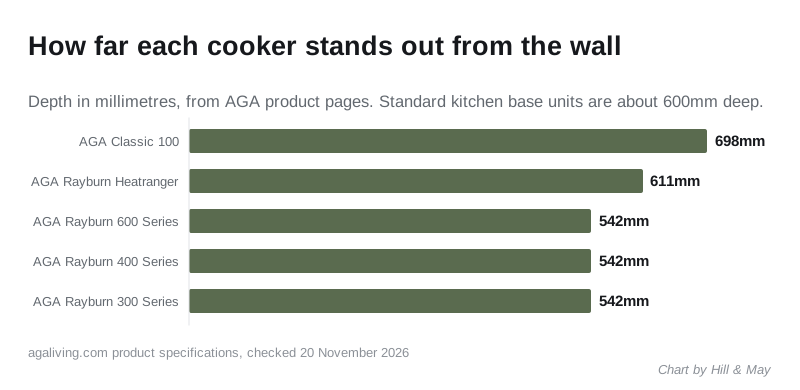
The chart above shows the gap. The AGA Classic 100 is 698mm deep, standing about 100mm proud of standard 600mm base units. The Rayburn 300, 400 and 600 Series are 542mm deep and sit back within a normal worktop run; the Heatranger is 611mm.
Widths: the AGA Classic 100 is 987mm, the Rayburn 300 Series 840mm, the 400 Series 905mm, the Heatranger 920mm and the 600 Series 995mm. All are heavy: the Classic weighs 444kg and the Rayburns 305 to 420kg, so check the floor before delivery. Our what size range cooker guide covers measuring the space.
A Rayburn also needs things an electric AGA does not: a flue, connection to your hot water cylinder and radiators, and a fuel supply. For oil that means a tank, which brings its own rules; see oil tank rules for an oil-fired AGA. The 400 Series runs on mains gas or LPG; our LPG cooker guide covers bulk tanks and bottles.
Servicing and upkeep
This is where an electric AGA wins clearly. AGA says the current Signature, Classic, Compact and Mini need no regular servicing, because there is nothing to burn.
A Rayburn burns fuel around the clock in winter, so it needs regular attention. AGA says a Rayburn should be serviced once or twice a year depending on the model. Oil Rayburns need an OFTEC-registered technician, and any gas Rayburn must be worked on by a Gas Safe registered engineer by law. Because a Rayburn is also your boiler, that service is your boiler service too; you are not paying for two. Our AGA servicing intervals page has AGA’s full schedule for older models.
Running costs
The two are hard to compare directly, because they are buying different things.
- An AGA’s bill is all cooking and kitchen warmth. AGA’s figure for a three-oven Classic on its economy setting is 105 kWh a week, about £27.64 a week at the October to December 2026 price cap rate of 26.32p per kWh. Using the lower settings and only switching the hotplates on to cook brings that down. Our AGA running costs guide does the annual sums.
- A Rayburn’s bill is mostly heating. Most of the oil or gas it burns goes to your radiators and hot water, which you would be paying for with a boiler anyway. The fair comparison is a Rayburn against an AGA plus a separate boiler, not a Rayburn against an AGA alone.
With oil, your cost moves with the heating oil price; we track it in heating oil price per litre.
Which should you buy?
Choose an AGA if:
- you already have a boiler or heat pump you are happy with;
- you want three ovens and the classic AGA way of cooking;
- you want no flue, no fuel tank and no routine servicing;
- the cooker can stand slightly proud of the worktop.
Choose a Rayburn if:
- you live off the gas grid and already heat with oil, or have mains gas or LPG;
- you want one appliance for cooking, hot water and radiators;
- you want the cooker to line up with 600mm units;
- you are happy to book a service once or twice a year.
If you are weighing a third maker, ESSE’s electric ranges and wood-fired cooker are covered in our heat storage cookers explained guide, and is an AGA worth it sets out the case for and against owning any of them.
For the current line-up and dealer details, see AGA’s Rayburn range.
Frequently asked questions
What is the difference between an AGA and a Rayburn? Both are cast-iron heat storage cookers from AGA. A new AGA is electric and only cooks. Every current Rayburn burns oil or gas, heats your hot water, and all but the 300 Series run central heating too.
Can a Rayburn heat a whole house? The larger ones can. AGA rates the 400 and 600 Series at up to 23.4kW and says they can run up to 16 radiators; the Heatranger 100K is rated at 29.3kW. The 300 Series heats hot water only.
Does an AGA heat your water or radiators? No. A current AGA warms the kitchen through its cast iron but has no boiler. You need a separate boiler or heat pump for hot water and heating.
Is a Rayburn cheaper to run than an AGA? Not directly comparable. A Rayburn’s fuel mostly goes on heating and hot water you would otherwise buy from a boiler, so compare it with an AGA plus a boiler. An AGA Classic on economy uses about 105 kWh of electricity a week on AGA’s figures.
Does a Rayburn need servicing? Yes. AGA says a Rayburn should be serviced once or twice a year depending on the model, by an OFTEC technician for oil or a Gas Safe engineer for gas. Current electric AGAs need no routine servicing.
Is there an electric Rayburn? AGA sold an all-electric cooking-only Rayburn Ranger, but it no longer appears on AGA’s Rayburn page. The current Rayburns all burn oil, HVO-compatible oil, natural gas or LPG.
Sources: AGA Classic 100, Rayburn 300, 400, 600 and Heatranger product pages on agaliving.com, checked 20 November 2026; AGA running cost and servicing figures from our sibling pages sourced to AGA. We have not cooked on these models in a test kitchen.