Aga, Rayburn and Heat-Storage Cookers
Heat Storage Range Cookers: How AGA, Rayburn and ESSE Differ

By the Hill & May team
Updated 2026
A heat storage range cooker cooks with heat it has already banked in a heavy block of cast iron, rather than heat it makes the moment you turn a knob. The ovens sit at fixed or programmed temperatures, the hotplate stays hot under an insulated lid, and the whole cooker gives off a gentle warmth into the kitchen. Three British names still make them: AGA in Telford, the AGA Rayburn from the same Shropshire foundry, and ESSE in Barnoldswick, Lancashire.
The short version of how they differ:
- AGA is a cooker. It heats the kitchen as a side effect but does not run your radiators or your hot water.
- AGA Rayburn is a cooker and a boiler in one. Every current Rayburn heats domestic hot water, and most run central heating too. All of them burn oil or gas.
- ESSE builds electric cast-iron ranges that plug into two 13 amp sockets and heat up in about 15 minutes from standby, plus one wood-fired range with an optional hot water boiler.
All model details below come from the makers’ own product pages, checked on 19 November 2026. Running costs use the October to December 2026 price cap rate of 26.32p per kWh for electricity.
How a heat storage cooker works
A conventional cooker heats the oven air when you ask it to and stops when you turn it off. A heat storage cooker puts energy into several hundred kilos of cast iron and lets it seep out slowly. A Rayburn 400 Series weighs 420kg; the Rayburn Heatranger 305kg. That mass is the point: it holds the oven steady when you open the door and slide in a cold joint, and it cooks mostly with radiant heat from the iron walls rather than with a fan blowing hot air.
Three things follow from that design, and they decide whether one suits you.
- It is ready when you are, if you leave it on. A traditional cooker running all day needs no preheating. Switch it off and it takes hours to come back up; a programmed modern one heats on a timer before you need it.
- It uses energy to stay hot, not just to cook. That standing loss warms the room in winter. In August it is heat you are paying for and do not want.
- You cook by moving food, not turning a dial. Each oven has its own job: roasting, baking, simmering, warming. Cooks learn which oven and which shelf, then barely touch the controls.
AGA: cast-iron cooking only
AGA’s current cast-iron range has three families. The AGA Classic is the three-oven cooker people picture. The AGA Signature (sold until recently as the eR7) keeps the cast-iron ovens but lets every oven and hotplate switch on and off on its own. The AGA Compact (the former eR3) pairs two cast-iron ovens with an induction hob and is 634mm deep, so it lines up with standard worktops where the Classic and Signature stand at 698mm.
None of them heats water or radiators. If that is what you want from a cast-iron cooker, AGA’s answer is a Rayburn.
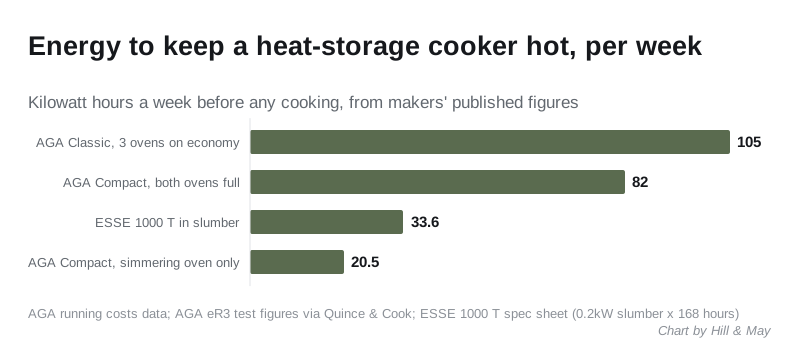
The cost of keeping an AGA hot depends almost entirely on how you run it. AGA’s figure for a three-oven Classic on its economy setting is 105 kWh a week, about £27.64 a week at 26.32p. The Compact with both ovens on full uses about 82 kWh a week on AGA’s test figures, and its simmering oven alone about 20.5 kWh. Our Aga eR7 review and Aga eR3 review cover each model, and our Aga running costs guide does the annual sums.
AGA Rayburn: a cooker that is also the boiler
AGA describes the Rayburn as “a true heat-storage cooker” with cast-iron ovens that cook by radiant heat, and the difference from an AGA is the boiler. AGA’s Rayburn page lists four current series:
| Model | Fuel | What it heats | Boiler output | Width x depth |
|---|---|---|---|---|
| Rayburn 300 Series (308K) | Oil | Cooking and hot water | 2.3kW, 140 litre hot water storage | 840 x 542mm |
| Rayburn 400 Series | Natural gas or LPG | Cooking, hot water, central heating | 17.6 to 23.4kW | 905 x 542mm |
| Rayburn 600 Series (680) | Oil | Cooking, hot water, up to 16 radiators | 23.4kW | 995 x 542mm |
| Rayburn Heatranger 100K | Oil, HVO compatible | Cooking, hot water, central heating | 29.3kW | 920 x 611mm |
The 400 Series is built to sit in line with standard 600mm kitchen units. The 600 Series has separate burners for the cooker and for the heating, so the radiators can run while the ovens idle and the other way round. The Heatranger’s oil burner can also run on HVO (hydrotreated vegetable oil), which matters if you want to stay on a cast-iron boiler cooker while cutting the carbon from your heating oil.
Because a Rayburn is your boiler, it needs a flue and a heating engineer, and it comes with the fuel’s own paperwork. Our oil tank rules for oil-fired Agas apply just as much to an oil Rayburn.
One model has gone quiet. The all-electric Rayburn Ranger, a cooking-only Rayburn sold through kitchen retailers from 2023, no longer appears on AGA’s Rayburn page. Ask a dealer before you plan a kitchen around one.
ESSE: electric cast iron that plugs in
ESSE has made cast-iron cookers in Lancashire since the 19th century, and its current range cooker line-up is almost all electric: the 600, 1000 and 1600 (the number is the width in millimetres), each in a T version with an induction zone beside a cast-iron hotplate and an X version with a larger hob. New PRO versions of each add more oven space; ESSE says the 1000 T PRO has 40% more oven capacity than the 1000 T.
The ESSE 1000 T is a good example of how the electric ESSEs differ from an AGA:
- It runs on two 13 amp sockets and needs no flue, so it can go almost anywhere in the kitchen.
- It has a 42 litre top oven with a full-width grill, a 30 litre oven and a slow cook oven, plus the cast-iron plate and an induction zone.
- From its low “slumber” setting the top oven reaches 240°C in 15 minutes and the hotplate reaches 300°C in 14 minutes, on ESSE’s figures.
- Slumber draws 0.2kW, which is 33.6 kWh across a week, or about £8.84 at 26.32p.
That makes the electric ESSE a hybrid. It has the cast-iron mass, the radiant ovens and some background warmth, but it behaves more like a fast conventional cooker than a traditional AGA. It does not heat water.
The exception is the ESSE 1000 W, a wood-burning range with three ovens totalling 126 litres. The 1000 WN gives 4.6kW of heat at 81.7% efficiency; the 1000 WD adds a hot water boiler for 7.6kW in total, 1.4kW of it to water. It needs a 150mm flue and a non-combustible floor. If you live in a smoke control area, check the rules on GOV.UK’s smoke control area page before you buy any wood-burning cooker.
Heat storage cooker running costs compared
| Cooker and setting | Energy per week to stay hot | Cost per week at 26.32p/kWh |
|---|---|---|
| AGA Classic, three ovens on economy | 105 kWh | £27.64 |
| AGA Compact, both ovens on full | about 82 kWh | £21.58 |
| ESSE 1000 T in slumber | 33.6 kWh | £8.84 |
| AGA Compact, simmering oven only | about 20.5 kWh | £5.40 |
These are standing figures, before any cooking, and they assume the cooker stays at that setting all week. Nobody runs a Compact with both ovens on full all day, and an ESSE spends part of the day above slumber when you cook, so treat them as the floor and ceiling of what keeping the iron warm costs. A Rayburn is harder to compare, because the same fuel heats your home: you are partly paying for heating you would otherwise buy from a boiler.
For the case for and against owning one at all, read our is an Aga worth it breakdown.
Which type suits which home
Choose an AGA if you want the classic cast-iron way of cooking, you have a separate boiler you are happy with, and you would like a cooker you can programme around your week. The Compact suits a kitchen where it must fit a standard worktop run.
Choose a Rayburn if you live off the gas grid, already burn oil, and want one appliance for the kitchen, the radiators and the hot water. It suits a farmhouse that lives in the kitchen through the winter. It suits less well a modern, well-insulated house, where a 23kW boiler is far more than you need.
Choose an electric ESSE if you want cast-iron cooking without a flue, without a long heat-up, and with a much smaller bill for keeping it warm. You give up some of the constant warmth.
Choose the ESSE 1000 W if you have a chimney, a wood supply and a taste for cooking on a real fire.
If you want to stop heating the house through the summer, see can you turn an Aga off in summer; for a cheaper way in, our reconditioned Aga buying guide covers what to check.
Frequently asked questions
What is a heat storage range cooker? It is a range cooker that stores heat in a heavy cast-iron body and cooks with that stored heat, mostly by radiation from the oven walls. The ovens stay at set temperatures, so there is little or no preheating, and the cooker warms the kitchen as it runs.
Is a Rayburn a heat storage cooker? Yes. AGA describes the Rayburn as a true heat-storage cooker with cast-iron, radiant ovens. Unlike an AGA, every current Rayburn also heats your hot water, and the 400, 600 and Heatranger models run central heating too.
Can a Rayburn heat a whole house? The bigger ones can. The Rayburn 600 Series boiler is rated at 23.4kW and AGA says it can power up to 16 radiators; the Heatranger 100K is rated at 29.3kW. The 300 Series only heats hot water, at 2.3kW.
Does an ESSE heat the kitchen like an AGA? Less so. An electric ESSE has cast-iron mass and gives off some warmth, but it idles at a low slumber setting drawing 0.2kW on the 1000 T, so it puts far less heat into the room than an AGA left on all day.
Do heat storage cookers need a flue? It depends on the fuel. Electric AGAs and electric ESSEs need no flue. Every current Rayburn burns oil or gas and needs one, as does the wood-burning ESSE 1000 W.
Which heat storage cooker is cheapest to keep hot? Of the published figures, the AGA Compact with only its simmering oven on uses about 20.5 kWh a week, and the ESSE 1000 T in slumber 33.6 kWh. A three-oven AGA Classic on economy uses 105 kWh a week.
Sources: AGA Rayburn product pages on agaliving.com, ESSE 1000 T, 1000 T PRO and 1000 W pages on esse.com, AGA figures from our sibling reviews sourced to AGA’s specification sheets, all checked 19 November 2026. We have not cooked on these models in a test kitchen.