Falcon, Lacanche and Premium Ranges
Lacanche Range Cooker Review: 650mm Deep, 51-Litre Ovens

Updated 2026
This Lacanche range cooker review starts with the two numbers most brochures leave until the small print. Every Lacanche stands 650mm deep, so in a British kitchen built for 600mm units it sits proud of the worktop. And the twin ovens on the best-known model, the 1000mm Cluny, hold 51 litres each with a fan, which is smaller than the main oven on a Falcon or Rangemaster of similar width.
What you get in return is a range built to order in Burgundy, a hob that can carry a 5kW burner or a cast iron French simmering plate, a choice of gas, static electric or fan for each oven, and a three-year warranty serviced by the importer’s own engineers. If you cook on the hob more than in the oven, and your kitchen can take the depth, a Lacanche is one of the most satisfying ranges you can buy. If you roast large joints for a crowd or bake on several trays at once, look hard at the oven sizes before you commit.
We built this review from the published specifications on the UK distributor’s site, Lacanche UK (run by Fourneaux de France Ltd in Poole), and from the retailer listing at Rangecookers.co.uk, checked on 12 November 2026. We have not cooked on a Lacanche in a test kitchen; where a view comes from owners rather than the specification, we say so.
Who makes Lacanche, and who sells it here
Lacanche ranges are made in the village of Lacanche in Burgundy, on a site with a long metalworking history. The Augagneur family bought the factory in 1981 and rebuilt the brand. In 2024 Lacanche joined Groupe SEB, the French group that owns Tefal, with Jean-Jacques Augagneur staying on in a leadership role.
In the UK and Channel Islands, Lacanche is represented exclusively by Fourneaux de France Ltd. You buy through a dealer, but the order, delivery, warranty and servicing all run through Fourneaux de France. That matters later, because it means one company stands behind the cooker, and its own engineers do the repairs.
The models, and what the names mean
Lacanche names its ranges after Burgundy villages and wines, which is charming and no help at all when you are choosing. The current UK line-up runs from 700mm to 2205mm wide. Every model is 900mm high and 650mm deep, and each is sold in a Classic finish (brass or chrome trims, traditional handles) or a Modern finish (flatter, more contemporary detailing) with the same insides.
These are the models most UK buyers shortlist, with the oven layout as Lacanche UK lists it:
| Model | Width | Ovens | Hob options | Weight (approx.) |
|---|---|---|---|---|
| Cormatin | 700mm | One large oven (gas 70 litres, or dual function electric 67 litres) plus a pan drawer | 3 or 4 burners, French top, or 3-zone induction | 80 to 90kg |
| Rully | 700mm | 67-litre dual function main oven plus a 27-litre electric grill oven | 3 or 4 burners, or French top | 90 to 100kg |
| Beaune / Bussy | 900mm | 65-litre vertical dual function side oven plus a main oven (fan 51, static 56 or gas 52 litres) | 6 burners or 6-zone induction | 100kg |
| Cluny | 1000mm | Two ovens, each fan 51, static 56 or gas 52 litres | 5 burners, French top, or 5-zone induction | 100 to 110kg |
| Macon | 1000mm | Two ovens as the Cluny, plus a 20-litre grill oven | 5 burners, French top, or 5-zone induction | 100 to 120kg |
| Volnay / Vougeot | 1000mm | One large oven (dual function 67 or gas 70 litres) plus a 79-litre simmer oven | 5 burners, French top, or 5-zone induction | 110 to 120kg |
| Saulieu / Savigny | 1105mm | 65-litre vertical side oven plus a large main oven (dual function 67 or gas 70 litres) | 3 or 4 burners, French top, or 3-zone induction, plus an extra hob module | 110 to 130kg |
The paired names in the table (Beaune and Bussy, Volnay and Vougeot, Saulieu and Savigny) share the same oven sizes on Lacanche UK’s listings and differ in layout, so look at the drawing of each to see where the tall oven, simmer oven or storage sits before you order. Above 1105mm the range runs on to the 1405mm Charlieu, Chablis and others, the 1505mm Citeaux and several 1805mm models, up to the 2205mm Vezelay. Our range cooker size guide explains how width maps onto real kitchens.
Oven sizes: the trade-off nobody mentions
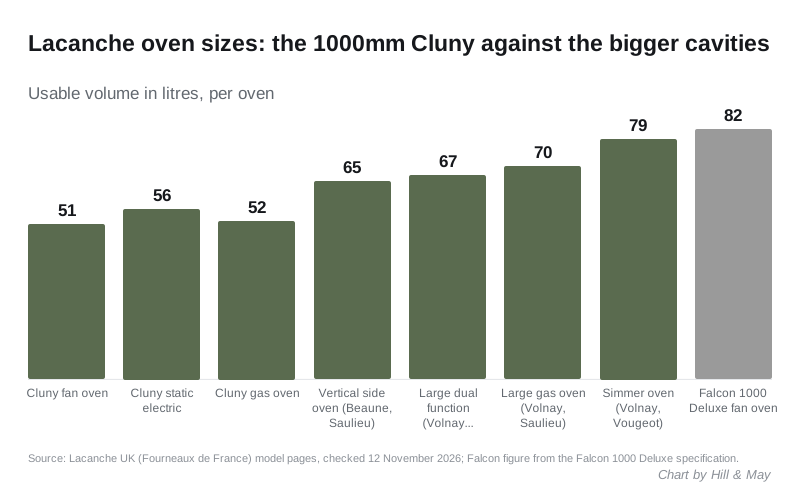
On the Cluny and Macon, both main ovens are 414mm wide inside. The fan version is 51 litres, the static electric 56 litres and the gas 52 litres. A fan takes space at the back of the cavity, which is why the fan oven is the smallest of the three even though Lacanche says two fan ovens is the most popular Cluny order.
For comparison, the Falcon 1000 Deluxe has a 78-litre multifunction oven and an 82-litre fan oven in a 990mm width. A large turkey or two full baking trays side by side is a squeeze in a 414mm-wide cavity.
The way round this, if you want a Lacanche, is to choose a layout with one large oven. The Volnay, Vougeot, Saulieu and Savigny all use a 550mm-wide main oven (67 litres dual function or 70 litres gas), and the 1105mm models add a 65-litre tall side oven as well. The Volnay and Vougeot pair the large oven with a 79-litre simmer oven for holding and slow cooking. See range cooker oven configurations for how to match ovens to the way you cook.
Every oven Lacanche lists, gas or electric, carries an A energy rating.
The hob: where Lacanche earns its reputation
The hob is the reason most people choose a Lacanche. The five-burner classic gas hob on the 1000mm Cluny, as Rangecookers.co.uk lists it, runs 5.0kW, 4.0kW, two 3.0kW and a 1.5kW burner, with push-button ignition, matt cast iron pan supports and a one-piece hob.
The alternative is the traditional hob: four open burners plus a large cast iron French top, a solid plate heated from a single burner beneath. The centre runs hottest and the edges cooler, so you move pans across it to control the heat instead of turning a knob. It is excellent for long simmering and keeping several things warm before serving, and when it is off it doubles as a work surface. It is also slower to heat up than an open burner and asks you to learn a new way of cooking, which is worth trying at a demonstration before you buy.
Without gas, the 1000mm models take a five-zone induction hob and the 900mm models a six-zone one. An induction Cluny needs a single-phase 230V, 50 amp supply on 10mm cable, according to Lacanche UK, which is more than many existing cooker circuits provide; get an electrician to check before you order. Our induction range cooker guide covers the wiring question in more detail.
On the larger models you can add hob modules such as extra gas burners, induction zones, a chargrill or an electric plancha.
Will it fit? Depth, doors and weight
This is the section to read twice.
Depth. Lacanche ranges are 650mm deep and are designed to sit proud of the units either side. Lacanche UK’s building-in guidance says adjoining units should sit flush with the main body of the cooker, not with its doors, so the side-opening doors can open wide enough to get the shelves out. If the furniture next to the range is deeper than 595mm, the cooker has to come forward, and Lacanche sells a 70mm island spacer to fill the gap behind.
Clearances. Above hob level you need at least 75mm between the cooker and any side surface, or 50mm if that surface is fireproof (tile, stone, glass or metal), and 800mm clear above the hob. Leave a 5mm gap either side when building into a run of units, an inglenook or a chimney breast.
Delivery. Doorways need to be at least 735mm wide. Standard delivery is two people to a ground floor room, unpacked for inspection, and the old cooker is not taken away. A Cluny weighs 100 to 110kg, so steps, tight turns and anything above the ground floor need to be declared on the delivery form, or extra charges and refused deliveries follow.
Height. All models are 900mm high, adjustable slightly on most listings. A high-mount kit is sold for 100cm models if your worktops are taller.
Ordering, lead times and commissioning
Every Lacanche is built to order. After you order through a dealer you get your own order web page, and Lacanche UK says it gives an estimated arrival date within about 10 working days; the actual delivery date is confirmed only when the cooker lands in the UK. Rangecookers.co.uk quotes up to 20 weeks for special order models. Order details cannot be changed once acknowledged, so check the colour, trim, hob and every oven before you confirm.
Lacanche UK is blunt that commissioning is crucial: a range not commissioned correctly will have burners and ovens that run too hot or too cold, and repairs caused by incorrect commissioning are not covered by the warranty. Use a Gas Safe registered engineer for gas or dual fuel models, and ask your dealer who they recommend. For LPG, Lacanche builds to order for bottled gas; our LPG cooker guide covers the supply side.
Warranty and servicing
The standard Lacanche warranty is three years, covering defects from faulty materials or workmanship. Fourneaux de France employs its own Gas Safe registered engineers for warranty work and uses genuine parts. The exclusions are longer than on many brands and worth knowing in advance. The warranty does not cover:
- enamelled inner or outer panels;
- pan stands, oven cavity parts, brass burners and burner bodies;
- brass, chrome or other trims;
- damage to the control panel from lifting or moving the range by the towel rail;
- problems caused by incorrect installation or commissioning.
You can buy a two-year extension when you order, covering electro-mechanical parts, callout and labour. A Lacanche is not a heat-storage cooker that runs all the time, so an annual service is not required, though Lacanche UK offers one after the warranty ends. Out-of-warranty repairs are charged as a callout plus time and parts; the current rates are on the Lacanche UK servicing page. Our page on range cooker warranty registration covers what to do on the day it arrives.
What owners say
Owner opinion on review sites and forums is broadly positive but comes from a small, self-selected sample, and many of the replies on Lacanche UK’s own review page come from the company. Several long-term owners describe cookers running for 15 to 20 years. The recurring complaints are about cost and waiting rather than the cooking: owners mention high out-of-warranty repair bills and, in a few cases, weeks waiting for an engineer. One point owners repeat is that a Lacanche is a manual cooker. It rewards people who like to control heat by eye and hand, and frustrates people who want programmes and timers.
Lacanche or something else?
Choose a Lacanche if you cook mostly on the hob, want a French top or a very powerful burner, like the idea of a hand-built cooker with a long working life, and have room for a 650mm-deep range.
Choose a Falcon if you want similar cast iron toughness and a 5kW burner but bigger ovens and a standard 600mm depth. Our Falcon review has the full specifications.
Choose a Rangemaster if you want glass oven doors, a timer and easier, cheaper parts; see the Rangemaster Classic 110 review.
Compare La Cornue, Mercury and ILVE in our premium range cookers explained, and widen the net with the best 100cm range cookers.
Check current price with your nearest Lacanche dealer: prices depend heavily on the hob, ovens, colour and trim you choose.
Frequently asked questions
Are Lacanche range cookers worth the money? For keen hob cooks, usually yes. You get a hand-built range, a 5kW burner or a French top, and a three-year warranty serviced by the importer’s own engineers. If you mainly use the oven, the 51-litre fan ovens on the Cluny are smaller than rivals at the same width.
Where are Lacanche cookers made? In the village of Lacanche in Burgundy, France, on the brand’s original factory site. In the UK they are imported and supported by Fourneaux de France Ltd in Poole, Dorset.
How deep is a Lacanche range cooker? 650mm, against the usual 600mm of British kitchen units. Lacanche designs them to sit proud of the adjoining cabinets, and sells a 70mm spacer if they have to be pulled further forward.
How long does a Lacanche take to arrive? Each one is built to order. Lacanche UK gives an estimated arrival date within about 10 working days of the order, and Rangecookers.co.uk quotes up to 20 weeks for special order models.
What is a French top on a Lacanche? A solid cast iron plate heated by one burner underneath. The centre is hottest and the edges cooler, so you slide pans to change the heat. It suits long simmering and keeping food warm, and doubles as a work surface when off.
Does a Lacanche need servicing every year? No. Lacanche UK says an annual service is not mandatory because the cooker is not on all the time, but it offers a service plan once the three-year warranty ends.