Buying Guides
Kitchen Shelves: 9 Ideas, With the Depths and Load Limits

By the Hill & May team
Updated 2026
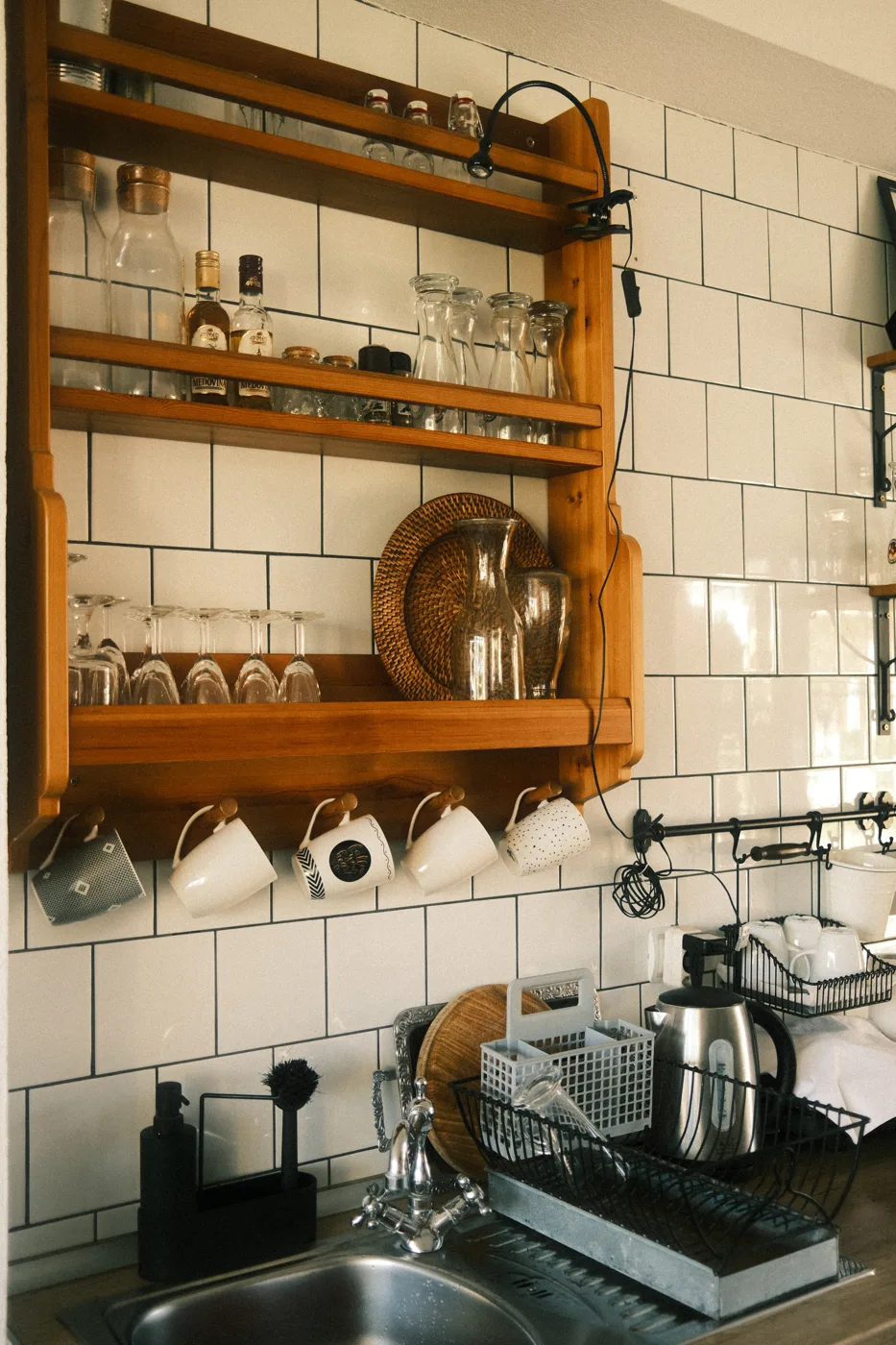
Most kitchen shelves fail for one of two reasons. Either they are too shallow to hold what people actually put on them, or they are fixed into plasterboard and slowly pull away from the wall. Neither is a design problem. Both are decided before you pick a finish, and both are fixable if you settle the depth and the fixing first.
So this runs through nine kitchen shelving ideas that work in a British kitchen, each with the dimension that makes it work and, where the manufacturer publishes one, the real load rating. Numbers here come from the makers themselves, not from a shelf that looked sturdy in a photograph.
First: the two numbers that decide everything
Depth. A dinner plate is about 27cm across, so a shelf under 25cm deep will not hold plates flat and you will end up stacking them at an angle. A shelf at 30cm holds plates, mixing bowls and a stack of side plates comfortably. Go past about 35cm and you start losing worktop light and knocking your head on it. For most kitchens, 30cm is the answer, and it is no accident that this is the depth the manufacturers settle on.
Height above the worktop. Standard British base units give you 150mm of leg, a 720mm carcass and a worktop of around 40mm, which puts the working surface at roughly 910mm off the floor. DIY Kitchens works from that arithmetic to a 490mm gap to the underside of wall units, and 500mm if the worktop is thicker. Shelves are not wall units, but the same gap applies: below 450mm you cannot get a kettle or a food processor under it, and you will resent the shelf every day.
1. A single run of open shelves instead of wall units
The classic swap. Take out one run of wall cupboards and put up two shelves at 30cm deep, the lower one about 500mm above the worktop and the second 350mm above that. You lose roughly half the storage volume of the cupboards you removed, which is the trade nobody mentions, and you gain a kitchen that feels twice the size.
It works best on a wall where you already keep things you use daily. Everyday plates, bowls, glasses and mugs get handled often enough that they never gather grease and dust. Put the annual roasting tin on an open shelf and you will be washing it before you use it.
2. Twin slot uprights, when you want to change your mind later
Twin slot shelving, the steel uprights with paired slots that brackets hook into, is the most flexible system in the kitchen and the most underrated. Shelf heights move in 25mm steps with no redrilling. Rothley’s twin slot brackets, sold through Toolstation and most builders’ merchants, are listed with a maximum load bearing capacity of 50kg, and come in lengths from 170mm up to 370mm so you can match the bracket to the shelf depth.
The usual mistake is a bracket shorter than the shelf. A 300mm shelf on a 220mm bracket has 80mm of unsupported front edge, which is where the tipping load is. Buy the bracket length that gets you within about 30mm of the front.
3. A suspension rail system, for a wall you cannot drill much
Rail systems hang everything off one horizontal rail rather than a grid of separate fixings, which concentrates the load into a line you can properly anchor into timber. IKEA’s KUNGSFORS range is the widely available example. The stainless steel KUNGSFORS shelf is 60cm wide, 30cm deep and 2cm thick with a published maximum load of 22kg, and hangs off the rail alongside hooks, a wall grid and a magnetic knife rack.
Note that 22kg. It is a stainless shelf and it sounds modest, but 22kg is roughly a full set of everyday crockery for four with room to spare. Published ratings are almost always lower than what people assume, and they are the number to design to.
4. Wooden shelves on concealed brackets
A kitchen with wooden shelves is the look most people are actually after, and the detail that makes or breaks it is thickness. Solid oak wall shelving is commonly sold at 18mm, 27mm and 40mm. The 18mm is display only: put jars on an 18mm oak shelf over a 900mm span and it will visibly bow within a year. 27mm is the sensible everyday thickness. 40mm is heavy, expensive, and reads as a statement rather than a shelf.
Concealed or floating brackets, the steel rods that slide into holes bored in the back edge, need thickness to work at all, which is another argument for 27mm minimum. They also transfer the whole load into two or three points on the wall, so they belong on masonry or a proper timber batten, never on plasterboard fixings alone.
If oak is the direction you are going, our oak kitchen ideas covers matching the shelf to the units so the two woods do not fight each other.
5. A shelf inside the cupboards you already have
Adding shelves to kitchen cupboards is the cheapest storage you will ever buy and the one people skip. A standard 720mm base carcass or a 720mm to 900mm wall carcass usually ships with one shelf and a full ladder of holes at 32mm centres. A second shelf costs the price of a cut panel and four pegs, and it halves the dead air above your mugs.
Measure the tallest thing that must live in that cupboard, add 20mm, and set the shelf there. Our kitchen wall units guide has the standard carcass heights to work from.
6. Pull-out kitchen storage instead of a deep shelf
Anything deeper than about 35cm should pull out rather than sit still, because the back of a deep shelf is a place things go to be forgotten. Pull-out kitchen storage is where the hardware makers publish the most useful numbers.
Blum’s SPACE TOWER, the tall larder built from stacked pull-outs, is rated by Blum at up to 70kg total per pull-out, which is why it can take bottles and tins rather than just packets. At the other end, Hafele’s Vauth-Sagel pull-out larder units go down to a 150mm cabinet width, with individual wire baskets rated at 16kg each.
That 150mm figure is the useful one. A 150mm gap is too narrow to be a cupboard and too narrow to be a drawer, but it is a perfectly good pull-out for oils, bottles and jars. See our tall kitchen units guide for where a larder tower fits in a run.
7. A freestanding kitchen shelving unit
Not every wall can take a fixing, and not every kitchen is yours to drill. A freestanding kitchen shelving unit, steel or timber, four or five tiers, solves the rented kitchen and the awkward corner. It also solves the microwave problem: put the microwave on a shelving unit rather than the worktop and you get your prep space back.
Look for adjustable feet, because kitchen floors are rarely flat, and check the depth against your walkway. A 45cm deep unit in a 900mm galley leaves 450mm to walk through, which is not enough with the oven door open.
8. A kitchen storage rack shelf over the hob or sink
A rail with hooks and a narrow shelf above it, over the sink or beside the hob, holds the things you reach for constantly: utensils, a colander, tea towels, the salt. The shelf here should be shallow on purpose, 12 to 15cm, because anything deeper hangs into your eyeline while you work.
Do not put this directly over a gas hob. Rising heat and fat will coat everything on it, and anything timber will dry out and crack.
9. Shelves in the corner, where the cupboard does not work
Corner base cupboards are the worst storage in any kitchen, which is why corner units come with carousels and pull-outs to rescue them. Above the worktop, the fix is simpler: two short open shelves running into the corner from each direction, stopping about 50mm short of each other so you can reach into both. No door to swing, no dead void, and the corner stops being wasted.
Load ratings, side by side
Every figure below is the manufacturer’s own published rating for that specific product. They are worth comparing, because they show how much difference the support method makes.
The fixing is the part that fails
None of the above matters if the shelf is screwed into 12.5mm plasterboard on its own. Plasterboard fixings are rated, and the good metal ones are genuinely useful, but every one of them is rated far below the same screw in masonry, and a kitchen shelf gets loaded and unloaded thousands of times.
Three options, best first:
- Into masonry. Most British kitchens have at least one solid external wall. Find it, use it for the heavy shelf, and put the light one on the stud wall.
- Into the studs or noggins. Studs in a modern British partition are usually at 400mm or 600mm centres. Two brackets on two studs is a proper fixing. If the stud spacing does not suit your shelf, fit horizontal noggins between the studs first, or run a timber batten across and fix the brackets to that.
- Plasterboard fixings alone. Only for a light shelf holding light things, and only with a metal fixing rated for the load with margin. Never for a floating bracket, which concentrates everything into two points.
Use a decent detector rather than knocking on the wall, and remember that a kitchen wall has cables and pipes in it. A shelf over a worktop is exactly the height where the sockets are wired.
Frequently asked questions
How deep should kitchen shelves be? 30cm for anything holding plates or bowls, because a dinner plate is about 27cm across and needs to sit flat. 12 to 15cm is right for a narrow rack shelf over a sink or a rail, where a deeper shelf would hang into your eyeline. Beyond 35cm, use a pull-out instead of a fixed shelf.
How much weight can kitchen shelves hold? It depends entirely on the support, not the shelf. Published examples: an IKEA KUNGSFORS stainless shelf is rated at 22kg, a Rothley twin slot bracket at 50kg, and a Blum SPACE TOWER pull-out at up to 70kg total. The wall fixing is usually the weakest link, so work to the manufacturer’s rating and only if you have fixed into masonry or timber.
Are open shelves practical in a kitchen? Yes, for things you use daily. Everyday plates, bowls, mugs and glasses get handled and washed often enough that dust and cooking grease never build up. Anything used a few times a year belongs behind a door. Also expect to lose roughly half the storage volume when you swap wall cupboards for two open shelves.
How thick should a wooden kitchen shelf be? 27mm for solid oak in everyday use. Solid oak shelving is commonly sold at 18mm, 27mm and 40mm: 18mm will bow under jars over a normal span, and 40mm is a design choice rather than a structural need. Concealed floating brackets need the extra thickness to house the rods, so 27mm is the practical minimum there too.
Can I put kitchen shelves on a plasterboard wall? Only lightly loaded ones, and only with metal fixings rated for the weight with a real margin. The better answer on a stud wall is to fix into the studs, usually at 400mm or 600mm centres, or to fit noggins or a timber batten first and fix the brackets to that. Floating brackets should never go into plasterboard alone.
What is the best way to add storage without losing wall space? Add a shelf inside the cupboards you already have. Most carcasses ship with one shelf and a full ladder of holes at 32mm centres, so a second shelf costs the price of a cut panel and four pegs and reclaims the dead air above your mugs. After that, look at pull-out storage in a 150mm or 300mm gap before you look at the walls.